


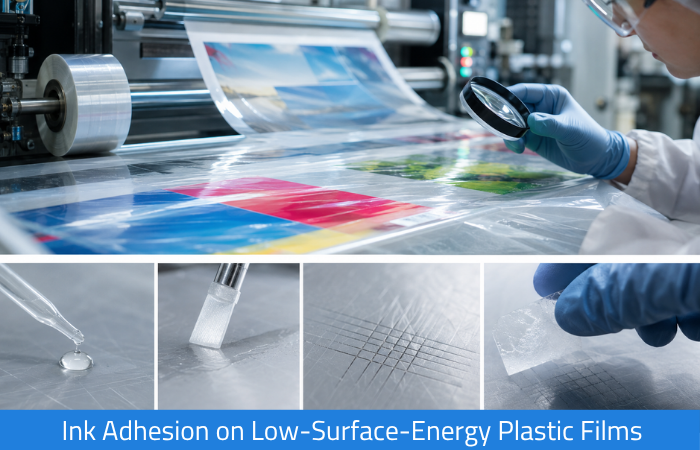
Printing on plastic films such as polyethylene, polypropylene and certain treated polyesters presents a persistent challenge for the flexible packaging and printing ink industry, because these substrates have low surface energy and resist wetting by standard printing ink formulations. An adhesion promoter is added to the ink or applied as a primer to raise adhesion between the ink and the plastic surface, preventing scuffing, delamination and print failure during lamination or end use. This article explains how adhesion promoters work, why difficult plastic substrates need them, and how printers and ink formulators can select the right adhesion promoter for consistent ink adhesion performance.
Why Plastic Substrates Resist Ink Adhesion
Most plastic films used in flexible packaging have inherently low surface energy compared with materials such as paper or metal, which means printing inks struggle to wet and bond to the surface without assistance. Untreated or lightly treated polyolefin films are particularly problematic, since their non polar chemical structure offers few sites for ink resins to anchor into. Even after corona or flame treatment raises the surface energy temporarily, that improvement can fade over time, especially in humid storage conditions, leaving printers with inconsistent adhesion results. This is where an adhesion promoter becomes essential, functioning as a bridge that chemically or physically links the ink resin system to the plastic surface and restores reliable ink adhesion even on difficult substrates.
How an Adhesion Promoter Works at the Molecular Level
An adhesion promoter typically contains reactive or polar functional groups that interact with both the plastic substrate and the ink binder resin. On one side, the promoter molecule anchors into the plastic surface through weak intermolecular forces or through reaction with residual polar groups created by surface treatment. On the other side, it presents functional groups that are compatible with the ink resin system, creating a molecular bridge that significantly increases peel strength and scuff resistance. Different adhesion promoter chemistries are formulated for different substrate and ink combinations, so understanding the specific plastic film and ink resin being used is the first step in selecting an effective adhesion promoter for printing inks.
Types of Adhesion Promoters Used in Printing Inks
Printing ink formulators use several categories of adhesion promoters, including chlorinated polyolefins, modified polymer resins and specialty additive blends designed for gravure and flexographic inks. Liquid adhesion promoter grades are convenient for dosing directly into the ink formulation during manufacturing, while other adhesion enhancer products are applied as a thin primer coat before printing. The correct choice depends on the printing process, the plastic substrate and whether the finished product needs to withstand lamination, retort processing or outdoor exposure. Ink formulators serving the flexible packaging industry often keep multiple adhesion promoter grades on hand to match the range of substrates their customers print on, from simple polyethylene bags to more demanding metallized or treated polyester films.
Key Categories of Adhesion Promoters for Printing Inks
Depending on the ink system, substrate and end-use requirements, adhesion promoters for printing inks can be broadly classified into several chemistry categories:
- Tackifier Chemistry: Used to enhance the tack, wetting and bonding characteristics of the ink, helping improve adhesion to challenging substrates.
- Chlorinated Polyolefins (CPO): Commonly used for improving adhesion to low-surface-energy polyolefin substrates such as polypropylene and polyethylene.
- Metal-Chelate Complexes: These promoters use metal-based coordination chemistry to improve interaction between the ink resin and substrate, supporting strong and durable adhesion.
- Phosphate-Based Adhesion Promoters: Designed to enhance interfacial bonding and can be useful where specific substrate and ink-resin compatibility is required.
- Ethyl Acetate-Soluble, Food-Grade-Compliant Adhesion Promoters: These grades are particularly relevant for flexible food packaging applications where solvent compatibility and applicable food-contact requirements are important considerations.
The appropriate chemistry should be selected based on the substrate, ink resin system, printing process, drying conditions and regulatory requirements of the final application.
Testing Ink Adhesion on Difficult Plastic Substrates
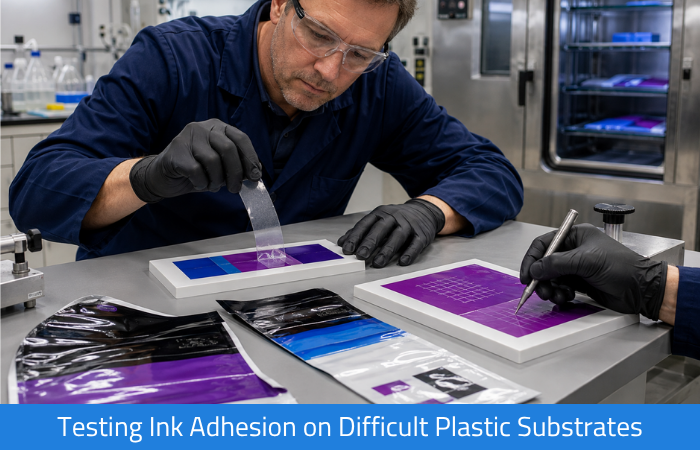
Before finalizing an ink formulation, printers routinely test adhesion using standard methods such as tape pull tests, crosshatch adhesion and scratch resistance evaluation. These tests are performed immediately after printing and again after conditioning, since adhesion promoter performance can vary with time as the ink cures fully. For substrates known to be particularly difficult, such as certain grades of polypropylene or films with slip additives migrating to the surface, formulators may also run accelerated aging tests to confirm that adhesion holds up during storage and transport. Consistent testing protocols help printers identify which adhesion promoter for plastic substrates delivers reliable results across production batches rather than only in laboratory conditions.
Selecting the Best Adhesion Promoter for Plastic Applications
Choosing the best adhesion promoter for plastic substrates involves balancing several factors including compatibility with the existing ink resin system, cost per kilogram, dosage level required and any regulatory requirements for food contact packaging. A high performing adhesion promoter should improve ink adhesion without negatively affecting print gloss, color strength or rub resistance. Printers should also confirm that the chosen adhesion promoter does not interfere with subsequent processes such as lamination adhesive bonding or overprint varnish application, since some promoters can affect surface energy in ways that impact downstream converting steps. Working closely with an experienced adhesion promoter manufacturer helps printers narrow down options quickly based on their specific substrate and process requirements.
Our Other Products
Synthetic Ketonic ResinAdhesion Promoters in Flexible Packaging Printing
Flexible packaging is one of the largest consumers of adhesion promoters because it combines demanding substrates with high speed printing processes and strict quality expectations from brand owners. Ink adhesion failures in flexible packaging can lead to product recalls, customer complaints and costly reprints, making adhesion promoter selection a critical quality control decision rather than a minor formulation detail. Printers working with metallized films, treated polyester or challenging polyolefin substrates rely on adhesion promoters to maintain consistent print quality across large production runs, and many ink manufacturers now offer adhesion promoter grades specifically optimized for the flexible packaging segment.
Working With an Experienced Adhesion Promoter Manufacturer
Because adhesion performance depends on precise chemistry and consistent quality, sourcing from a reliable adhesion promoter manufacturer is essential for ink formulators and printers who cannot afford production downtime caused by adhesion failures. Tridev Group manufactures adhesion promoters that help printing inks bond reliably to difficult plastic substrates, supporting flexible packaging converters who need dependable performance across polyethylene, polypropylene and treated film substrates. A good adhesion promoter supplier will also provide technical support to help formulators troubleshoot adhesion issues on specific substrates, reducing trial and error time during new product development. Long term customers also benefit from batch to batch consistency, since a stable adhesion promoter supply chain means printers spend less time recalibrating formulations every time a new drum of material arrives on the production floor.
Compatibility With Lamination and Overprint Processes
Many flexible packaging structures require the printed film to be laminated with another layer of plastic or foil, or coated with an overprint varnish for gloss and protection. The adhesion promoter chosen for the printing ink must remain compatible with these downstream processes, since a promoter that improves ink to substrate adhesion but weakens bond strength with the laminating adhesive creates a different failure point further along the production chain. Printers producing laminated pouches or wrappers should validate the full structure, not just the printed ink film, by running bond strength tests after lamination to confirm that the adhesion promoter supports every layer of the finished package rather than solving one adhesion problem while creating another.
Read Our Article
Choosing the Right Adhesion Promoter: Quality Parameters to ConsiderPractical Tips for Improving Ink Adhesion in Production
Beyond selecting the right adhesion promoter, printers can improve overall ink adhesion outcomes by monitoring corona or flame treatment levels regularly, storing plastic film rolls under controlled humidity conditions, and avoiding excessive time between substrate treatment and printing. Even the best adhesion promoter cannot fully compensate for a substrate that has lost its surface treatment due to prolonged storage. Combining proper substrate handling practices with a well matched adhesion promoter gives printers the most consistent path to strong, durable ink adhesion on difficult plastic substrates across every production run.
Dosage Levels and Formulation Balance
Adding an adhesion promoter to a printing ink is not simply a matter of using as much as possible, since excessive dosage can affect ink viscosity, drying speed and film clarity. Ink formulators typically start with the dosage recommended by the adhesion promoter manufacturer and then fine tune the level through incremental trials on the actual plastic substrate being printed. Too little adhesion promoter leaves adhesion below acceptable levels, while too much can create a soft or tacky film that affects block resistance during roll storage. Finding this balance requires close collaboration between the ink formulator and the adhesion promoter supplier, particularly when a new substrate or a new ink resin system is introduced into production.
Common Mistakes That Undermine Ink Adhesion Performance
Even with a well chosen adhesion promoter, several practical mistakes can undermine ink adhesion in production. Printers sometimes assume that once an adhesion promoter is added to the formulation, substrate surface treatment and storage conditions no longer matter, which is rarely true. Others fail to retest adhesion when switching to a new roll of film from a different resin supplier, even though subtle differences in slip additive content or surface treatment can change adhesion behavior significantly. Regular quality control checks, clear communication with substrate suppliers about treatment levels, and periodic retesting of adhesion promoter dosage all help printers avoid the intermittent adhesion failures that are often traced back to overlooked variables rather than the adhesion promoter itself.
Reliable ink adhesion on difficult plastic substrates depends on selecting an adhesion promoter that matches both the substrate chemistry and the ink resin system in use. By understanding how adhesion promoters function and testing performance systematically, printers and ink formulators can avoid costly adhesion failures and deliver consistent print quality. Partnering with an established adhesion promoter manufacturer such as Tridev Group gives flexible packaging converters the technical support and consistent product quality needed to solve even the most demanding plastic substrate adhesion challenges.
- Phenolic Resin Manufacturing Process: From Raw Material to Finished Product
- Questions to Ask a Phenolic Resin Manufacturer Before Placing an Order
- Alkyl Phenol Formaldehyde Resins Market Demand in Asia and Middle East
- Alkyl Phenol Formaldehyde Resin vs Conventional Phenolic Resin
- What Is Alkyl Phenol Formaldehyde Resin and Where Is It Used