


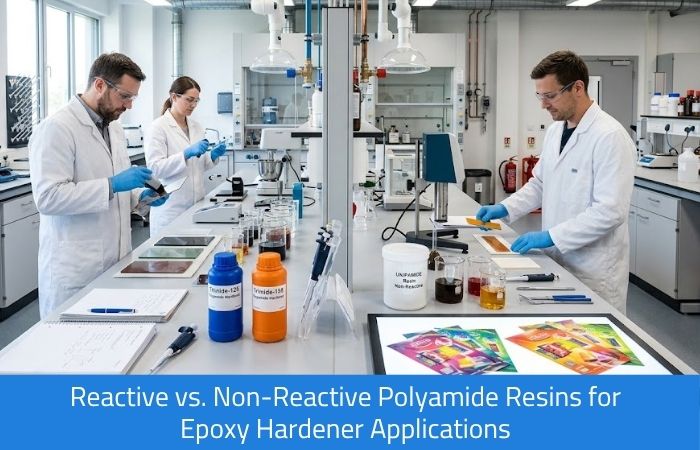
Polyamide resins serve two distinct roles in industrial formulations – one as a curing agent, the other as a film-forming binder. Understanding this divide helps formulators choose the right grade for their system, whether they are developing a protective coating or a printing ink. Tridev’s Trimide range addresses both ends of this spectrum, with reactive grades like Trimide-125 and Trimide-126 for epoxy curing and a broader series of non-reactive grades for ink and coating applications.
Epoxy Hardener Chemistry: What Makes a Resin Reactive?
An epoxy hardener must contain free amine groups capable of reacting with epoxide rings. Reactive polyamide resins are synthesized from dimerized fatty acids and polyamines and the resulting product retains sufficient amine functionality to crosslink with liquid epoxy systems at room temperature or mild heat. This crosslinking creates a three-dimensional polymer network that determines the final coating’s mechanical and chemical performance.
Non-reactive polyamide resins, by contrast, are synthesized to consume or block available amine groups during manufacture. They contribute no curing activity and are used instead for their thermoplastic film-forming, adhesion and solubility properties – particularly in printing ink systems where heat-reactive chemistry would be counterproductive.
Reactive Polyamide Resin Grades: Trimide-125 and Trimide-126
Trimide-125 and Trimide-126 are Tridev’s liquid reactive polyamide resin offerings. Both present as clear brown viscous liquids, which is characteristic of high-molecular-weight polyamide solutions with active hydrogen groups available for epoxy cure.
Trimide-125 is formulated for epoxy adhesive systems where corrosion resistance and surface aesthetics are the primary targets. In marine, industrial maintenance and metal protection coatings, an epoxy hardener based on reactive polyamide resin imparts flexibility alongside chemical resistance – a combination that brittle amine hardeners cannot consistently deliver. The long-chain fatty acid backbone of the polyamide introduces molecular flexibility that allows the cured film to withstand substrate movement, thermal cycling and moisture without microcracking.
Trimide-126 supports multi-purpose epoxy formulations that need both protective performance and surface finish. In systems where a coating must meet aesthetic criteria – gloss, levelling or color clarity – alongside corrosion and chemical protection, a reactive polyamide resin helps the formulator manage viscosity, pot life and film build more predictably than with aliphatic amine hardeners alone.
In both grades, the amine value determines stoichiometry: the formulator must calculate the epoxide equivalent weight of the chosen epoxy resin and match it against the active hydrogen equivalent of the Trimide grade to achieve full cure and avoid under- or over-hardening.
Read Our Article
Comparing Ketonic Resins with Phenolic and Polyamide ResinsNon-Reactive Polyamide Resin Grades: The Trimide Ink Series
The non-reactive segment of the Trimide range – covering grades 202, 209, 209HP, 301, 302, 304, 502 and 503 – is engineered entirely around solvent-based ink and coating performance. These grades share a yellow lump appearance and differ primarily in softening point, viscosity (measured in FCB4 seconds) and the solvent system they are designed for.
Trimide-202 and Trimide-209 are co-solvent polyamide resins intended for flexographic and gravure printing inks, with Trimide-209 offering a faster flow rate. Trimide-209HP extends this into overprint varnish territory. Trimide-301 is the general-purpose alcohol-soluble grade for flexo and gravure, while Trimide-302 and Trimide-304 address cold-chain packaging – grades specifically developed for deep-freeze and freeze-thaw environments where ink adhesion and flexibility must survive repeated thermal shock.
At the lower softening point end, Trimide-502 and Trimide-503 cover untreated polyolefin substrates such as HDPE, PP and PE – surfaces that present significant adhesion challenges. Trimide-503 is particularly tailored to non-treated polyolefin printing, where conventional ink resins fail to wet the surface adequately.
None of these grades participates in epoxy curing chemistry. Selecting a non-reactive polyamide resin as an epoxy hardener would result in an uncured or improperly cured system, since no active crosslinking occurs.
Key Differences That Drive Formulation Decisions
The selection between reactive and non-reactive polyamide resin comes down to what role the resin plays in the final product.
In an epoxy adhesive or protective coating, the hardener drives cure kinetics, crosslink density, flexibility and ultimately the substrate adhesion and chemical resistance of the film. A reactive polyamide resin like Trimide-125 or Trimide-126 is not a passive ingredient – it is a stoichiometric participant. The ratio, cure temperature and pot life must all be controlled.
In a printing ink, the resin is a passive film-former dissolved in solvent. It contributes to adhesion to substrate, gloss, rub resistance and printability, but it does not react. Solubility profile, viscosity and compatibility with pigments and other binders matter more than amine value.
Softening point also signals the application space. Trimide-125 and Trimide-126 are liquids, suited for room-temperature or slightly elevated-temperature epoxy cure. The non-reactive ink grades are solid lumps that dissolve into solvent systems – a physical form incompatible with liquid epoxy hardener use.
Our Other Products
Rosin Modified Ester GumWhen to Use Reactive Polyamide Resins
Reactive polyamide resins are the right choice when the formulation target is a crosslinked epoxy network. Protective industrial coatings, metal primers, pipeline coatings, marine topcoats and structural adhesives all require this chemistry. The polyamide-epoxy system is preferred over pure amine curing in applications where:
Flexibility is needed alongside chemical resistance, such as on flexible metal structures or thin-walled containers. Pot life must be extended beyond what fast-reacting aliphatic amines allow. Surface tolerance is required – polyamide epoxy hardeners cure more forgivingly on surfaces with marginal moisture or surface preparation. Aesthetic performance (gloss retention, no blushing) is part of the product brief.
Trimide-125 addresses the corrosion-focused, adhesive end of this range. Trimide-126 covers broader multi-purpose formulations where finish quality is also a specification requirement.
When to Use Non-Reactive Polyamide Resins
Non-reactive polyamide resins are the right choice when the system is solvent-based, thermoplastic and designed for printing or surface coating without a chemical cure step. The Trimide ink grades are optimized for:
Co-solvent and alcohol-based flexographic and gravure ink systems. Packaging applications that must survive low-temperature storage and distribution. Printing on difficult substrates like untreated HDPE, PP and PE where surface energy is low. Overprint varnish applications where a clear, fast-drying protective layer is required over printed ink.
Using a reactive polyamide resin in these applications would introduce amine functionality into a system that has no epoxy component to react with, creating performance variability and potential stability issues in the ink formulation.
Positioning Trimide in the Market
Tridev’s Trimide range is positioned to serve both the epoxy coatings sector and the flexible packaging and printing ink industry from a single product family. The reactive grades – Trimide-125 and Trimide-126 – address the demand for polyamide-based epoxy hardener that balance toughness, flexibility and corrosion protection. The non-reactive grades – from the co-solvent series through the polyolefin-specific grades – address the ink formulator’s need for resins that adhere, flow and dry correctly across a range of substrates and storage conditions.
The clear split between these two product groups reflects a fundamental chemistry difference: one reacts, the other does not. Matching the right Trimide grade to the right application is not a preference – it is a formulation requirement.
Conclusion
Choosing between reactive and non-reactive polyamide resins is not a matter of performance preference – it is a chemistry-driven decision that directly affects whether a formulation works at all. Reactive polyamide resins like Trimide-125 and Trimide-126 function as true epoxy hardeners, building crosslinked networks that deliver corrosion resistance, flexibility and surface protection in industrial and adhesive applications. Non-reactive polyamide resin grades across the Trimide ink series serve an entirely different purpose – film formation, substrate adhesion and printability in solvent-based systems – without any curing activity. Tridev’s Trimide range, spanning both reactive and non-reactive polyamide resin grades, gives formulators in the coatings, adhesive and printing ink industries a clearly differentiated product set, each grade engineered for the chemistry and performance demands of its specific end use.
- Phenolic Resin Manufacturing Process: From Raw Material to Finished Product
- Questions to Ask a Phenolic Resin Manufacturer Before Placing an Order
- Alkyl Phenol Formaldehyde Resins Market Demand in Asia and Middle East
- Alkyl Phenol Formaldehyde Resin vs Conventional Phenolic Resin
- What Is Alkyl Phenol Formaldehyde Resin and Where Is It Used