


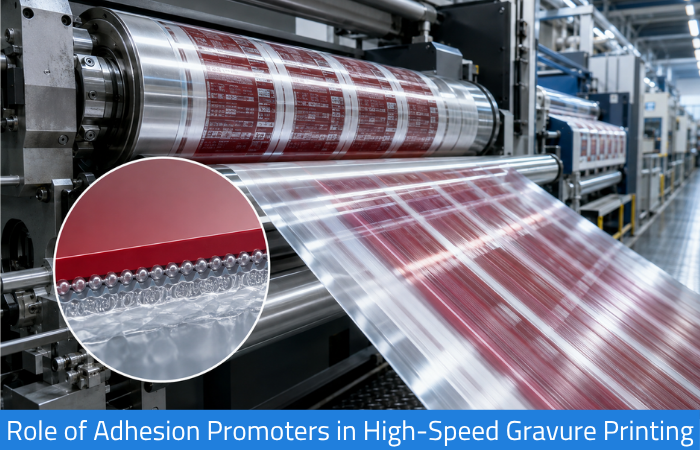
Gravure printing runs at very high press speeds, often exceeding several hundred meters per minute, which places unique demands on ink formulation and substrate adhesion. At these speeds, ink must transfer cleanly from the engraved cylinder, wet the substrate almost instantly and develop adhesion strength before the printed web moves on to drying, lamination or slitting. An adhesion promoter plays a central role in making this possible, especially when printing on plastic films, foils and other low surface energy substrates common in flexible packaging. This article explores how adhesion promoters function within high speed gravure printing and what formulators should consider when selecting the right adhesion promoter for demanding production environments.
Why High Speed Gravure Printing Places Extra Demand on Adhesion
Unlike slower printing processes, gravure printing gives ink very little dwell time on the substrate before the web moves into the drying oven. This compressed timeframe means the adhesion promoter must act quickly to establish a bond between the ink resin and the substrate surface, since there is no opportunity for the ink to slowly penetrate or wet the film as might happen in slower processes. Any weakness in adhesion promoter performance becomes immediately visible as scuffing, poor rub resistance or delamination during downstream lamination, making adhesion promoter selection one of the most critical variables in gravure ink formulation for flexible packaging and publication printing alike.
How Adhesion Promoters Support Ink Transfer and Bonding
An adhesion promoter used in gravure printing typically works by modifying the surface interaction between the ink and the substrate, either through the ink formulation itself or through a primer coating applied before printing. The promoter increases the wetting behavior of the ink on low energy substrates such as polyethylene and polypropylene films, allowing the ink to spread evenly rather than beading or forming a discontinuous film. Once applied, the adhesion promoter also helps the ink resin anchor into the substrate surface during the brief solvent flash off period, so that by the time the printed web reaches the nip rollers and winding station, sufficient bond strength has already developed to withstand handling and further processing.
Selecting an Adhesion Promoter for Gravure Ink Systems
Gravure inks are typically solvent based and formulated with specific resin systems such as nitrocellulose, polyamide or polyurethane resin binders, and the adhesion promoter chosen must be fully compatible with these binder chemistries. A liquid adhesion promoter that disperses evenly into the ink vehicle without affecting viscosity or drying speed is ideal for high speed production, since any inconsistency in ink rheology can disrupt cylinder metering and cause print defects. Formulators should also confirm that the adhesion promoter does not interfere with color strength or gloss, since gravure printing is often used for high value packaging where visual appearance is as important as adhesion performance.
Major Adhesion Promoter Chemistries Used in Gravure Inks
Different adhesion promoter chemistries can be selected depending on the substrate, ink resin system and performance requirements of the gravure application. Common categories include:
- Tackifier Chemistry: Helps improve wetting, tack and bonding between the ink and difficult substrates, supporting consistent adhesion during high-speed printing.
- Chlorinated Polyolefins (CPO): Particularly useful for polyolefin films such as polypropylene and polyethylene, where achieving strong ink adhesion can be challenging.
- Metal-Chelate Complexes: These provide a reactive or coordinating mechanism that can improve bonding between the ink system and substrate and are useful where enhanced adhesion and durability are required.
- Phosphate-Based Adhesion Promoters: These are used to improve interfacial bonding in selected ink and substrate combinations and can provide an alternative chemistry where conventional promoters are not suitable.
- Ethyl Acetate-Soluble, Food-Grade-Compliant Adhesion Promoters: These are relevant to solvent-based gravure inks used in food packaging, particularly where ethyl acetate compatibility and applicable food-contact requirements need to be considered.
For high-speed gravure printing, the selected chemistry should provide strong adhesion while maintaining compatibility with the ink binder, solvent system, viscosity, drying speed and downstream lamination requirements.
Varnish Adhesion Promoter Applications in Gravure Printing
In addition to being blended directly into printing inks, ink adhesion promoters are also used within overprint varnishes applied after printing to protect the ink layer and add gloss or matte finish. A varnish adhesion promoter helps the protective coating bond firmly to the printed ink film, preventing the varnish from scratching off or delaminating during handling, especially on high speed converting lines where printed rolls are unwound and rewound multiple times. Selecting the right varnish adhesion promoter is particularly important for packaging that will be exposed to friction during transport or retail handling, since a weak bond between varnish and ink layer can lead to visible scuffing that affects brand presentation.
Testing Adhesion Promoter Performance Under Production Conditions
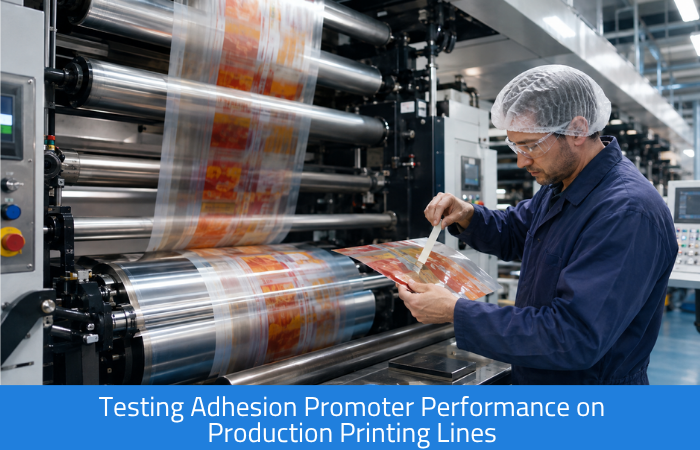
Because laboratory conditions do not always replicate the speed and mechanical stress of a live gravure press, many printers validate adhesion promoter performance through pilot runs on production equipment before committing to full scale use. Tape pull tests, scratch resistance evaluation and lamination bond strength testing are performed on samples taken directly from the press to confirm that adhesion holds up under real world speed and tension conditions. This step is especially important when switching to a new substrate, a new ink resin system or a new adhesion promoter grade, since even minor formulation changes can behave differently at production speed compared with slow laboratory application methods.
Adhesion Promoters in Flexible Packaging Gravure Applications
Flexible packaging is one of the largest applications for high speed gravure printing, covering products such as snack food wrappers, pouches and laminated films. In this segment, adhesion promoters must support not only initial print adhesion but also compatibility with subsequent lamination adhesives, since most flexible packaging structures combine multiple film layers bonded together after printing. Printers serving the flexible packaging industry often rely on adhesion promoter suppliers who understand the full production chain, from ink formulation through lamination, so that adhesion performance is optimized across every stage rather than solving one adhesion challenge while introducing a new one further down the line.
Our Other Products
Reactive Polyamide ResinWorking With an Experienced Adhesion Promoter Supplier
Given the speed and precision required in gravure printing, working with an experienced adhesion promoter manufacturer helps printers avoid costly production downtime caused by adhesion related defects. Tridev Group manufactures adhesion promoters suited to high speed gravure printing applications, supporting ink formulators who need consistent performance across demanding production environments and challenging plastic substrates. A responsive adhesion promoter supplier can also assist with troubleshooting when new substrates or ink systems are introduced, helping printers maintain consistent quality without slowing down production schedules. Long term supply relationships with a dependable adhesion promoter manufacturer also give printers priority access to technical guidance whenever a new substrate or ink resin combination needs to be validated quickly.
Training Press Operators on Adhesion Promoter Best Practices
Even the best adhesion promoter formulation depends on correct handling at the press, so training press operators to recognize early signs of adhesion trouble is a valuable investment for gravure printing facilities. Operators who understand how solvent flash off, cylinder temperature and web tension interact with adhesion promoter performance can catch problems early, before an entire roll of printed material is wasted. Building this knowledge into standard operating procedures, alongside clear guidance from the adhesion promoter supplier on dosage and handling, helps printing facilities maintain consistent adhesion quality across shifts and operators rather than depending on the experience of a single technician.
Balancing Speed, Cost and Adhesion Quality
High speed gravure printing operations are under constant pressure to maximize throughput while minimizing waste from adhesion related rejects. Choosing an adhesion promoter that delivers reliable bonding at production speed reduces the risk of costly reprints and helps maintain consistent quality across long production runs. While premium adhesion promoter grades may carry a higher per kilogram cost, the reduction in waste, rework and customer complaints often outweighs this initial cost difference, particularly for printers serving brand owners with strict quality specifications for their packaging.
Types of Adhesion Promoters Suited to Gravure Applications
Gravure printers can choose between several categories of adhesion promoters depending on the substrate and ink system in use, including chlorinated polyolefin based promoters, modified resin blends and liquid additive concentrates designed for easy dosing at the ink kitchen. Each type of adhesion promoter offers a different balance of wetting speed, compatibility and cost, and gravure printers often maintain more than one grade to match the range of substrates they print, from simple polyethylene films to more demanding metallized or biaxially oriented polypropylene structures. Understanding the types of adhesion promoters available and matching them correctly to substrate and ink chemistry helps printers avoid the trial and error that can slow down new job setup on a busy production floor.
Managing Viscosity and Rheology When Adding Adhesion Promoters
Because gravure printing depends on precise ink metering through engraved cylinders, any change to ink viscosity or rheology caused by adding an adhesion promoter must be carefully managed. Press operators typically monitor viscosity with a flow cup throughout the run and adjust solvent addition to maintain consistent ink transfer, since an adhesion promoter that thickens the ink unexpectedly can cause cylinder flooding, poor dot reproduction or streaking on the printed web. Ink formulators should work closely with their adhesion promoter supplier to understand how a given dosage level affects rheology across the full production temperature range, since ambient conditions on the press floor can shift viscosity behavior compared with controlled laboratory testing.
Adhesion promoters play an essential role in enabling reliable, high quality output from high speed gravure printing operations, particularly when printing on plastic substrates common in flexible packaging. By understanding how adhesion promoters function during the compressed timeframe of gravure printing and testing performance under real production conditions, printers can maintain consistent adhesion quality at speed. Partnering with a knowledgeable adhesion promoter manufacturer such as Tridev Group gives gravure printers the technical support needed to keep pace with demanding production schedules while protecting print quality.
- Phenolic Resin Manufacturing Process: From Raw Material to Finished Product
- Questions to Ask a Phenolic Resin Manufacturer Before Placing an Order
- Alkyl Phenol Formaldehyde Resins Market Demand in Asia and Middle East
- Alkyl Phenol Formaldehyde Resin vs Conventional Phenolic Resin
- What Is Alkyl Phenol Formaldehyde Resin and Where Is It Used