

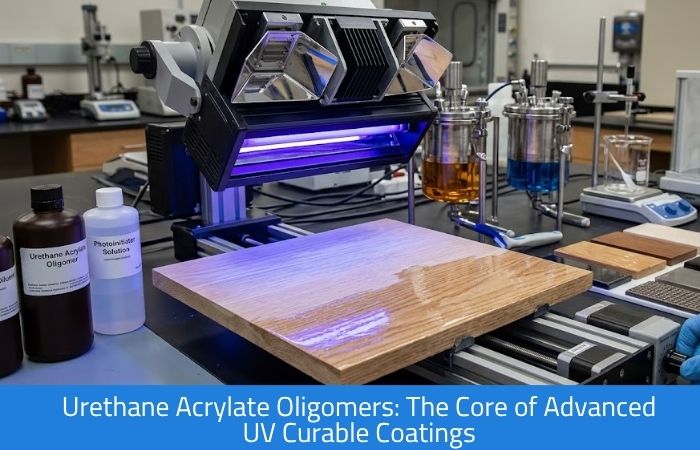
UV curable coatings have become a preferred technology across wood finishing, printing inks, electronics and industrial coatings because they cure in seconds under ultraviolet light rather than hours in a conventional oven, saving energy and floor space on the production line. At the heart of most UV curable formulations sits the urethane acrylate oligomer, a reactive backbone that determines the flexibility, hardness, adhesion and chemical resistance of the finished film. This article explains what urethane acrylate oligomers are, how they compare with other oligomer types used in UV curing, and how formulators can select the right grade of UV oligomer for their specific coating application.
What Urethane Acrylate Oligomers Are and How They Cure
A urethane acrylate oligomer is formed by reacting a polyisocyanate with a hydroxyl functional acrylate compound, producing a reactive oligomer that carries acrylate end groups capable of rapid free radical polymerization under UV light. When exposed to ultraviolet radiation in the presence of a photoinitiator, these acrylate groups crosslink almost instantly, transforming a liquid coating into a solid film within seconds. This fast, energy efficient curing mechanism is what makes urethane acrylate oligomers so valuable for high speed production lines where thermal curing ovens would otherwise slow throughput considerably. The urethane linkage within the oligomer backbone also contributes flexibility and toughness that many other acrylate oligomer types cannot match on their own.
Comparing Urethane Acrylate With Epoxy Acrylate and Polyester Acrylate Oligomers
Formulators choosing a UV oligomer typically compare urethane acrylate oligomer against epoxy acrylate and polyester acrylate options, since each oligomer family brings a different balance of properties to the cured film. Epoxy acrylate oligomers generally provide excellent hardness, chemical resistance and fast cure speed, making them popular for wood coatings and graphic arts varnishes, but they tend to be more brittle than urethane acrylate systems. Polyester acrylate oligomers offer good flexibility and lower cost, though often with reduced weathering performance compared with urethane acrylate. Urethane acrylate oligomers strike a distinctive balance, delivering high flexibility, strong abrasion resistance and good adhesion, which is why they are frequently specified for applications that require the cured film to withstand bending, impact or repeated flexing without cracking.
Aliphatic Versus Aromatic Urethane Acrylate Oligomer Chemistry
Urethane acrylate oligomers are broadly divided into aliphatic and aromatic types based on the isocyanate used during synthesis, and this distinction has a significant impact on outdoor performance. Aliphatic urethane acrylate oligomers resist yellowing under UV exposure and are the preferred choice for exterior coatings, automotive clear coats and any application where long term color stability matters. Aromatic urethane acrylate oligomers tend to be more economical and offer excellent hardness and chemical resistance, but they can yellow when exposed to sunlight, making them better suited to indoor applications such as electronics coatings, printed circuit board finishes and interior wood coatings where UV exposure is limited. Selecting between aliphatic and aromatic urethane acrylate oligomer chemistry is one of the first decisions formulators must make when developing a new UV curable coating.
Functionality and Molecular Weight Considerations
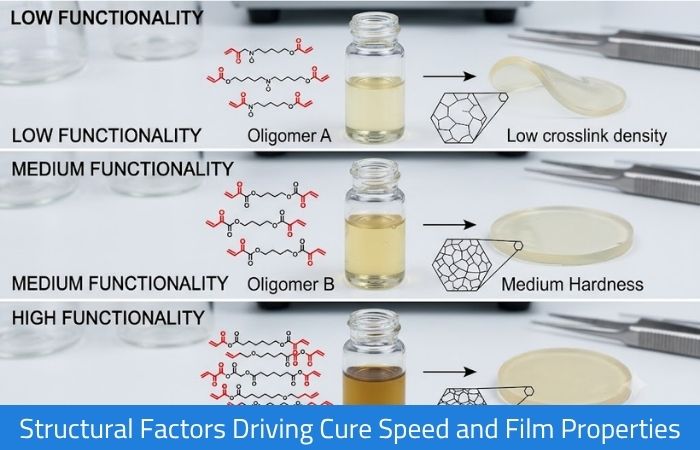
The functionality of a urethane acrylate oligomer, meaning the number of reactive acrylate groups per molecule, directly influences crosslink density, cure speed and final film hardness. Higher functionality oligomers cure faster and produce harder, more chemically resistant films, but can also become more brittle, while lower functionality grades offer greater flexibility at the cost of slower cure speed. Molecular weight also plays an important role, since higher molecular weight urethane acrylate oligomers generally produce more flexible, tougher films with better elongation, while lower molecular weight versions cure to harder, more rigid coatings. Formulators must balance these properties against viscosity requirements as well, since molecular weight and functionality both affect how easily the oligomer can be processed and diluted with reactive monomers during formulation.
Our Other Products
Synthetic Ketonic ResinViscosity Management and Reactive Diluents
Urethane acrylate oligomers are typically supplied at fairly high viscosity, so formulators blend them with reactive diluent monomers to achieve workable application viscosity without introducing non reactive solvents that would need to be evaporated before cure. The choice of reactive diluent affects not only viscosity but also cure speed, flexibility and adhesion of the final film, since the diluent itself becomes part of the crosslinked network once curing is complete. Selecting a compatible diluent system for a given urethane acrylate oligomer requires understanding how the diluent’s own functionality and polarity interact with the oligomer backbone, and formulators often run small scale trials to confirm the combination delivers the desired balance of application viscosity and cured film performance.
Applications Across Wood, Ink and Industrial Coatings
Urethane acrylate oligomers serve a wide range of end use markets, including wood furniture finishes where flexibility and scratch resistance are essential, printing ink resins and overprint varnishes where fast cure speed supports high production line speeds, and polyurethane resins for coatings on plastic and metal components requiring abrasion resistance and good adhesion. In flexible packaging and label printing, urethane acrylate oligomer based UV curable inks and coatings are valued for their ability to withstand folding and handling without cracking, a property less common in more rigid epoxy acrylate systems. Electronics manufacturers also rely on urethane acrylate oligomers for conformal coatings and protective finishes that must remain flexible while resisting moisture and chemical exposure throughout the product’s service life.
Photoinitiator Selection and Its Impact on Cure Performance
The performance of any urethane acrylate oligomer formulation depends not only on the oligomer itself but also on the photoinitiator system used to trigger polymerization under UV light. Different photoinitiators respond to different wavelengths and light intensities, and mismatching the photoinitiator to the curing equipment or to the pigment loading in a colored coating can result in incomplete cure, particularly at the bottom of thicker films where UV penetration is limited. Formulators working with urethane acrylate oligomers should test photoinitiator combinations under their actual curing lamp setup, whether mercury vapor, LED or another UV source, since cure depth and surface tack free performance can vary considerably between photoinitiator packages even when the base oligomer remains unchanged.
Read Our Article
Specialized Resins for Adhesives, Rubber, and Automotive SectorsStorage Stability and Handling of UV Oligomers
Urethane acrylate oligomers are reactive by design, which means proper storage is essential to prevent premature polymerization or viscosity drift before the material reaches the coating line. Most UV oligomer products include a small amount of inhibitor to extend shelf life, but exposure to heat, light or oxygen depletion during storage can still gradually reduce the effective working life of the material. Formulators and production teams should store urethane acrylate oligomers in sealed, opaque containers away from direct sunlight and excessive heat, and should rotate stock on a first in first out basis to avoid using material that has aged beyond its recommended shelf life, which can affect both viscosity and final cure performance.
Selecting the Right UV Oligomer Grade for Your Formulation
Choosing the correct urethane acrylate oligomer requires matching functionality, molecular weight, aliphatic or aromatic chemistry and viscosity to the specific performance targets of the coating project, whether that involves outdoor durability, high gloss, flexibility or fast cure speed. Formulators new to UV curable technology should request technical data sheets and application guidance from their UV oligomer supplier, along with sample quantities for laboratory scale trials, before committing to bulk purchase. Testing cured film properties such as pencil hardness, adhesion, flexibility and gloss under actual production conditions gives formulators the confidence that the selected urethane acrylate oligomer will perform reliably once scaled up to full production volumes.
Our Other Products
Non Reactive Polyamide ResinSourcing Reliable Urethane Acrylate Oligomers
Because UV curable coating performance depends so heavily on consistent oligomer quality, sourcing from an established UV oligomer manufacturer is essential for formulators who cannot afford variability in cure speed or film properties from batch to batch. Tridev Group is a leading resins manufacturer that produces urethane acrylate oligomers and other UV oligomer chemistries used across wood coatings, printing inks and industrial coating applications, supporting formulators who need dependable performance across demanding production environments. Working with a knowledgeable oligomer supplier also provides access to technical guidance on formulation troubleshooting, helping shorten development timelines when introducing new UV curable products to the market. Buyers who build a strong working relationship with their oligomer supplier also gain faster access to new grades as UV curable technology continues to evolve across coatings, inks and adhesive applications.
Urethane acrylate oligomers remain one of the most versatile and widely used building blocks in UV curable coating technology, offering a valuable combination of flexibility, toughness and adhesion that few other oligomer chemistries can match. Formulators who understand the differences between aliphatic and aromatic grades, functionality options and reactive diluent compatibility are well positioned to select the right urethane acrylate oligomer for their specific application, and partnering with an experienced UV oligomer manufacturer such as Tridev Group ensures consistent quality throughout the development and production process.
- Phenolic Resin Manufacturing Process: From Raw Material to Finished Product
- Questions to Ask a Phenolic Resin Manufacturer Before Placing an Order
- Alkyl Phenol Formaldehyde Resins Market Demand in Asia and Middle East
- Alkyl Phenol Formaldehyde Resin vs Conventional Phenolic Resin
- What Is Alkyl Phenol Formaldehyde Resin and Where Is It Used