


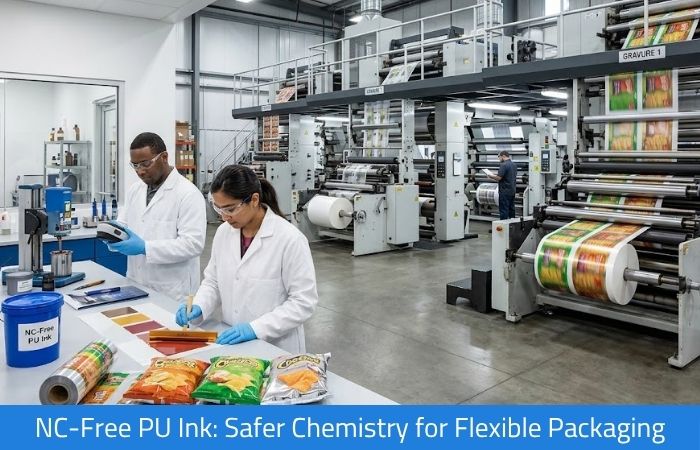
NC-Free PU Ink: The Shift Starting at the Chemistry Level
NC-free PU ink, short for nitrocellulose-free polyurethane ink, is a printing ink system where the traditional nitrocellulose (NC) binder is completely replaced by a polyurethane-based resin. In flexible packaging printing, the binder is the backbone of any ink formulation – it determines adhesion, flexibility, chemical resistance and how the ink interacts with substrates like BOPP, PET, nylon and metalized films.
Conventional gravure and flexographic inks used in flexible packaging have relied on nitrocellulose as the primary resin for decades. NC is derived from cellulose nitrate – a chemically modified plant material that is highly flammable and classified as a hazardous substance under multiple international transport regulations. That single characteristic has become a growing liability for packaging converters, brand owners and ink manufacturers worldwide.
Nitro cellulose free PU ink replaces that hazardous binder entirely with a polyurethane resin system, delivering comparable or superior print performance while eliminating the transport, storage and safety risks tied to nitrocellulose-based ink systems.
Why the Flexible Packaging Industry is Moving Away from Nitrocellulose
Regulatory Pressure Is Accelerating the Transition
The movement away from NC-based inks is not merely a trend driven by innovation – it is increasingly driven by tightening global regulations. Nitrocellulose is classified as a Division 4.1 flammable solid under UN transport regulations, which triggers strict handling requirements across air, sea and road freight. In the European Union, REACH compliance and evolving food contact material (FCM) regulations are pushing ink manufacturers to reformulate. In India, the Bureau of Indian Standards (BIS) and food packaging compliance norms are equally tightening around volatile organic compound (VOC) emissions and migration limits from packaging inks.
Brand owners producing food, pharmaceutical and personal care packaging can no longer afford the regulatory ambiguity that comes with NC-containing ink systems, especially as sustainability reporting and extended producer responsibility (EPR) frameworks expand globally.
PU Resin for NC-Free Ink: How the Replacement Actually Works?
The core technology enabling this shift is the development of high-performance PU resin for NC-free ink. Polyurethane resins used in this application are engineered to replicate the fast-drying, high-gloss and adhesion properties that made nitrocellulose dominant in the first place.
Modern polyurethane resin systems designed for nitro cellulose free polyurethane ink are typically supplied as alcohol-soluble or ester-soluble grades. The choice of solvent system directly affects drying speed, printability on high-speed rotogravure presses and inter-coat adhesion in multi-layer laminate structures.
What differentiates a well-formulated PU resin for NC-free ink is its ability to maintain viscosity stability during long print runs, provide strong bonding to corona-treated films and support both surface printing and lamination applications – areas where nitrocellulose has historically had an advantage due to its fast solvent release profile.
Read Our Article
Choosing the Right Adhesion Promoter: Quality Parameters to ConsiderNC-Free Polyurethane Ink Match Up: Performance Gap
One of the most practical questions flexible packaging converters ask is whether NC-free polyurethane ink performs on par with nitrocellulose ink in real press conditions. The answer has changed significantly in recent years as polyurethane resin technology has matured.
On key performance parameters – print sharpness, color density, drying at press speeds above 200 m/min and lamination bond strength – advanced nitro cellulose free PU ink formulations are now matching or outperforming their NC counterparts. The flexibility profile of polyurethane resins is inherently superior to nitrocellulose, making NC-free PU ink particularly well-suited for applications involving stretch films, stand-up pouches and retort packaging where ink cracking is a rejection risk.
The primary area where converters have historically faced adjustment is in drying speed, since nitrocellulose releases solvents very rapidly due to its low molecular weight. However, newer PU resin formulations with optimised solvent balance are narrowing this gap considerably.
Sustainability and Food Safety Drivers behind the Switch
The food packaging sector is at the forefront of adopting NC-free PU ink because of two interlocking concerns: solvent retention and migration risk.
Nitrocellulose ink formulations typically use ethyl acetate, isopropanol or toluene-based solvent blends. Residual solvent retention in printed flexible films is a known risk factor for off-odour complaints and chemical migration into food products. Regulatory bodies including the European Food Safety Authority (EFSA) and national equivalents are continuously reducing permissible migration thresholds for printing ink components.
Nitro cellulose free PU ink systems, when formulated with low-migration polyurethane resins and clean solvent packages, offer a more controlled migration profile. Additionally, polyurethane resins do not carry the inherent instability risks of nitrocellulose when subjected to heat, moisture or long storage – an important factor for packaging used in humid tropical climates or exported across multiple geographies.
Our Other Products
Synthetic Ketonic ResinWhere NC Ink Falls Short: Recycling Compatibility
The global shift toward mono-material flexible packaging – a core requirement for recyclability under frameworks like the EU Packaging and Packaging Waste Regulation (PPWR) and the Ellen MacArthur Foundation’s Global Commitment – has exposed a critical weakness of nitrocellulose ink.
When NC-printed packaging enters polyolefin film recycling streams, nitrocellulose residues from the ink layer can contaminate the recycled resin, affecting melt properties and discolouring recyclate. This is not a minor technical footnote – it is a structural incompatibility with circular economy targets.
NC-free PU ink formulations based on polyurethane resins with low ash content and clean burn profiles are significantly more compatible with film recycling processes. For packaging converters whose brand owner clients are committed to recyclability targets by 2025–2030, switching to nitro cellulose free polyurethane ink is not optional – it is a prerequisite for material compliance.
Supply Chain and Logistics: The Hidden Cost of Keeping NC Ink
Beyond performance and regulation, there is a logistics dimension to the NC-to-PU transition that is often underestimated. Because nitrocellulose is classified as a hazardous flammable solid, its transport requires special documentation, segregated storage conditions, fire suppression infrastructure and additional insurance compliance. Ink manufacturers, distributors and converters all absorb these costs invisibly.
Switching to NC-free PU ink removes the ink from hazardous goods classification in most jurisdictions (subject to formulation and solvent system), simplifying procurement, warehousing and international shipment – particularly relevant for converters who export printed films or import inks across borders.
NC-free Polyurethane Ink: Market Driving the Industry
Leading flexible packaging markets in Europe, Southeast Asia and increasingly India are seeing accelerated adoption of NC-free polyurethane ink. Ink manufacturers have invested significantly in developing PU resin for NC-free ink that meets the full technical brief of high-speed gravure printing without compromise on optical density, press stability or lamination compatibility.
The transition is no longer a question of if – it is a question of timeline and formulation readiness. Converters who are already qualifying nitro cellulose free PU ink on their presses are gaining a competitive advantage by aligning with regulatory direction, recyclability requirements and brand owner sustainability commitments simultaneously.
The flexible packaging industry is at an inflection point. NC-free polyurethane ink is not a niche alternative – it is becoming the new baseline for responsible, compliant and future-ready flexible packaging production.
Conclusion
The flexible packaging industry’s move away from nitrocellulose toward NC-free PU ink reflects a convergence of regulatory tightening, recycling mandates, food safety standards and supply chain practicality. NC-free polyurethane ink, backed by advanced PU resin technology, now delivers the press performance converters need while eliminating the flammability, migration and recyclability risks tied to nitrocellulose systems. As brand owners accelerate their sustainability commitments and packaging regulations grow stricter across global markets, nitro cellulose free polyurethane ink is fast becoming the industry-standard choice – not as an alternative, but as the responsible default for modern flexible packaging production.
- PVB Resin for Structural & Hot-Melt Adhesives in Saudi Arabia’s Construction
- PVB Resin Demand in Brazil’s Furniture Coatings Industry
- PVB Resin for Etch Primers in Lebanon’s Construction Sector
- PVB Resin in Etch Primers for Peru Mining & Heavy Equipment
- PVB Resin for Etch Primers in Mexico’s Automotive Industry