


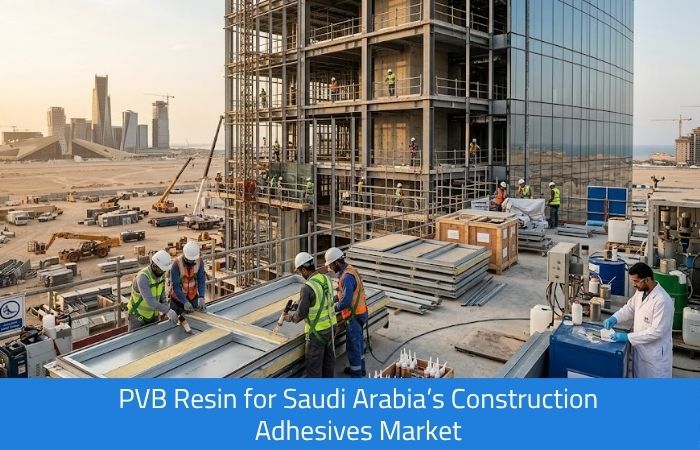
Saudi Arabia’s Construction Boom and Adhesive Demands
Saudi Arabia’s construction sector is one of the most active in the world, driven by Vision 2030 mega-projects that include Neom (the futuristic city in Tabuk Province), the Red Sea Project, Diriyah Gate in Riyadh, Qiddiya, and the ongoing expansion of infrastructure across Riyadh, Jeddah, Mecca, Medina, Dammam, Al Khobar, Jubail, Yanbu, and Khamis Mushait. This construction pipeline, which encompasses commercial towers, hospitality facilities, transportation infrastructure, industrial plants, and residential developments, creates exceptional demand for high-performance adhesive systems — including structural adhesives for glass, metal, and composite substrates, and hot-melt adhesives for interior finishing, furniture, and panel lamination. Polyvinyl butyral resin (pvb resin) is an important functional component in several of these adhesive categories.
Polyvinyl Butyral Uses in Structural Adhesives
Understanding polyvinyl butyral uses in structural adhesive applications requires an appreciation of the pvb polymer’s fundamental chemistry. pvb polyvinyl butyral is a thermoplastic resin with a pvb chemical structure containing hydroxyl groups that can react with isocyanates, epoxies, melamines, and other crosslinker systems to form thermoset networks with enhanced adhesive strength and environmental resistance. The polyvinyl butyral properties most relevant to structural adhesives are: outstanding adhesion to glass, metal, aluminium, ceramics, and plastics; high flexibility and toughness that allows adhesive joints to absorb dynamic loads; pvb resin solubility in common adhesive solvents; and the ability to be formulated as both solvent-based and hot-melt systems. What is polyvinyl butyral in a hot-melt context? pvb plastic material offers thermoplastic flow at moderate processing temperatures, enabling hot-melt adhesive formulations with excellent wetting on substrates and strong bond formation upon cooling.
Structural Glass and Façade Bonding in Saudi Arabia
Saudi Arabia’s iconic commercial and hospitality architecture — exemplified by Riyadh’s King Abdullah Financial District, Jeddah’s waterfront towers, and the ultra-modern façades of Neom’s planned developments — makes extensive use of structural glazing systems where adhesive bonding plays a critical role. pvb binder systems in structural glass adhesives must meet strict performance criteria: adhesion of the glass interlayer to the glass pane, resistance to the extreme temperatures characteristic of Saudi summer conditions, transparency and colour stability over decades of UV exposure, and the ability to maintain structural integrity under the lateral wind loads experienced by tall buildings in coastal locations like Jeddah and Al Khobar. pvb coatings-based adhesive systems, particularly when combined with suitable crosslinkers, meet these demanding criteria with a track record developed over decades of use in architectural glazing worldwide.
Hot-Melt Adhesives for Saudi Arabia’s Interior Construction
The interior finishing, furniture, and panel lamination sectors of Saudi Arabia’s construction economy represent a large and growing market for hot-melt adhesives containing pvb binder. In Riyadh, Jeddah, and the tourism facilities of the Red Sea coast and Mecca, high-specification interior finishing demands adhesive systems that combine rapid processing speed with strong, durable bonds on wood, MDF, aluminium sections, and decorative laminates. pvb resin coatings in hot-melt formulations deliver fast set speed, high final bond strength, and excellent heat resistance — critical in Saudi Arabia’s extreme summer temperatures where adhesive joint temperatures in non-air-conditioned spaces can rise significantly above ambient. pvb resin development for Saudi construction applications has focused on extending the upper service temperature of hot-melt systems without compromising application viscosity or open time.
Our Other Products
Synthetic Ketonic ResinThe Polyvinyl Butyral Resin Market in Saudi Arabia
The polyvinyl butyral market in Saudi Arabia is fed by imports through the ports of Jeddah Islamic Port and Dammam’s King Abdul Aziz Port. European and North American pvb manufacturers have historically been the primary suppliers, but the Kingdom’s construction-driven growth in specialty chemical demand is creating significant opportunities for competitive Indian Polyvinyl Butyral Resin Exporters. Indian pvb manufacturers supply pvb powder and pre-dissolved pvb solution grades that meet the adhesive industry’s technical specifications, at polyvinyl butyral price points that are attractive to Saudi formulators managing the raw material costs of high-volume construction projects. For companies in Saudi Arabia that buy polyvinyl butyral resin, establishing relationships with multiple reliable polyvinyl butyral suppliers — including Indian sources — provides supply chain resilience in a market where project timelines are critical.
Tridev Resins: Polyvinyl Butyral Resin Manufacturer for Saudi Arabia
Tridev Resins is an established Polyvinyl Butyral Resin Manufacturer and Polyvinyl Butyral Resin Exporter with a strong presence in the Gulf Cooperation Council market. Our Tripol PVB Resins range for adhesive applications offers Saudi construction sector formulators and adhesive manufacturers the consistent pvb resin production quality, application-specific technical guidance, and competitive commercial terms they require. As your Polyvinyl Butyral Resin Supplier for structural and hot-melt adhesive applications, Tridev Resins brings deep expertise in polyvinyl butyral (pvb) chemistry and a commitment to supporting pvb resin development for Saudi Arabia’s world-class construction projects.
Conclusion
Saudi Arabia’s Vision 2030 construction programmes represent one of the world’s most significant infrastructure investment opportunities, and high-performance adhesive systems are central to realising the quality standards these projects demand. Polyvinyl butyral pvb resin, as a versatile pvb binder for both structural and hot-melt adhesive formulations, delivers the adhesion, flexibility, and heat resistance that Saudi construction adhesives must achieve. polyvinyl butyral manufacturers with the technical depth and supply reliability to serve this demanding market are well positioned to be strategic partners in the Kingdom’s construction transformation.
- PVB Resin for Structural & Hot-Melt Adhesives in Saudi Arabia’s Construction
- PVB Resin Demand in Brazil’s Furniture Coatings Industry
- PVB Resin for Etch Primers in Lebanon’s Construction Sector
- PVB Resin in Etch Primers for Peru Mining & Heavy Equipment
- PVB Resin for Etch Primers in Mexico’s Automotive Industry