


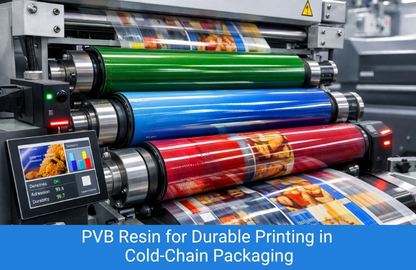
Russia’s Cold-Chain Packaging Challenge
Russia’s vast geography – stretching from Moscow and St. Petersburg in the west to Novosibirsk, Yekaterinburg, and Vladivostok in the east – creates one of the world’s most demanding cold-chain logistics environments. Frozen food, dairy products, pharmaceuticals, and industrial chemicals must be packaged in flexible films that maintain print integrity at temperatures ranging from −30°C in Siberian distribution to ambient conditions in retail settings. For the printing inks applied to these packages, adhesion failure, ink cracking, and colour bleed under thermal cycling are constant risks. This is precisely where polyvinyl butyral (PVB polyvinyl butyral) resin delivers decisive performance advantages
Understanding PVB Resin in Cold-Chain Ink Systems
What is polyvinyl butyral from a functional perspective? It is a thermoplastic PVB polymer produced by reacting polyvinyl alcohol with butyraldehyde, yielding a resin whose PVB chemical structure provides a unique combination of mechanical flexibility, substrate adhesion, and chemical resistance. These polyvinyl butyral properties make PVB resin an ideal binder for solvent-based flexographic and gravure inks used on PE, CPP, and nylon films – the substrates most common in Russian cold-chain packaging.
At low temperatures, many conventional resin binders become brittle, causing ink films to crack when packaging is flexed or dropped. PVB coatings resist this brittleness because the butyral groups in the PVB chemical structure impart inherent flexibility to the cured film. The PVB binder maintains elongation and toughness even at sub-zero temperatures, ensuring that printed text, barcodes, and branding remain legible and intact throughout the cold chain.
Ink Adhesion on Challenging Substrates
Russian flexible packaging producers in industrial cities such as Moscow, St. Petersburg, Kazan, Chelyabinsk, and Rostov-on-Don frequently print onto films that present adhesion challenges: low surface energy polyolefin films, metallised films, and moisture-barrier laminates. PVB resin solubility in alcohols and ketones enables formulators to create ink systems with excellent wetting characteristics on these difficult substrates. The hydroxyl groups within the PVB polymer chain interact with corona-treated film surfaces, creating strong interfacial adhesion that survives condensation, freeze-thaw cycling, and mechanical handling.
The PVB plastic material also offers compatibility with a wide range of plasticisers and co-resins, allowing Russian ink formulators to fine-tune adhesion, flexibility, and dry speed to match specific press configurations and substrate requirements. polyvinyl butyral PVB can be blended with nitrocellulose, acrylics, or polyurethane resins to create hybrid binder systems optimised for high-speed flexo presses operating in plants from Nizhny Novgorod to Krasnodar.
PVB Resin Production and Sourcing for Russian Ink Manufacturers
Russia’s ink and coatings manufacturing base has historically relied on European polyvinyl butyral suppliers, but evolving trade dynamics have accelerated interest in high-quality PVB resin suppliers from India and Asia. Indian PVB manufacturers now offer PVB powder grades that meet international viscosity, molecular weight, and purity specifications, with competitive polyvinyl butyral price structures that appeal to Russian ink producers managing tightening margins.
For companies looking to buy polyvinyl butyral resin for cold-chain ink applications, the key specification parameters are viscosity grade, degree of acetalization, and residual hydroxyl content – all of which influence ink film flexibility and adhesion performance. Established polyvinyl butyral resin manufacturers supply detailed technical data sheets and application support to help Russian formulators select the correct grade of PVB Resins for their specific cold-chain packaging requirements.
Our Other Products
Non Reactive Polyamide ResinThe Polyvinyl Butyral Market in Russia
Russia’s polyvinyl butyral resin market is shaped by the country’s strong food processing industry, its pharmaceutical sector, and its sizeable industrial packaging base. Moscow and the Moscow Oblast represent the largest single demand concentration, followed by St. Petersburg, which hosts numerous packaging converters serving the Baltic export market. Yekaterinburg and Novosibirsk serve as regional hubs for Siberian food production, while Kazan’s growing chemical industry represents an emerging centre for specialty resin consumption. The polyvinyl butyral market across these regions is characterised by growing demand for performance ink resins that can withstand Russia’s extreme temperature range.
Tridev Resins: Your Polyvinyl Butyral Resin Supplier for Russia
As a leading Polyvinyl Butyral Resin Manufacturer and Polyvinyl Butyral Resin Exporter, Tridev Resins supplies PVB polymer grades specifically suited to cold-chain flexible packaging ink formulations. Our Tripol PVB Resins range provides Russian ink manufacturers with consistent PVB resin production quality, technical expertise, and the flexibility to source premium polyvinyl butyral (PVB) at globally competitive prices. Whether your operation is in Moscow, Kazan, or Novosibirsk, Tridev Resins is committed to supporting your PVB resin development and formulation goals.
Conclusion
Russia’s cold-chain packaging sector demands ink performance that conventional resin systems often cannot deliver. polyvinyl butyral PVB resin, with its exceptional flexibility, strong substrate adhesion, and cold-temperature film integrity, is the binder of choice for serious flexible packaging ink formulators serving this challenging market. By partnering with a reliable polyvinyl butyral resin supplier, Russian ink producers can build superior cold-chain ink systems that protect brand integrity from factory floor to frozen shelf.
- Phenolic Resin Manufacturing Process: From Raw Material to Finished Product
- Questions to Ask a Phenolic Resin Manufacturer Before Placing an Order
- Alkyl Phenol Formaldehyde Resins Market Demand in Asia and Middle East
- Alkyl Phenol Formaldehyde Resin vs Conventional Phenolic Resin
- What Is Alkyl Phenol Formaldehyde Resin and Where Is It Used