


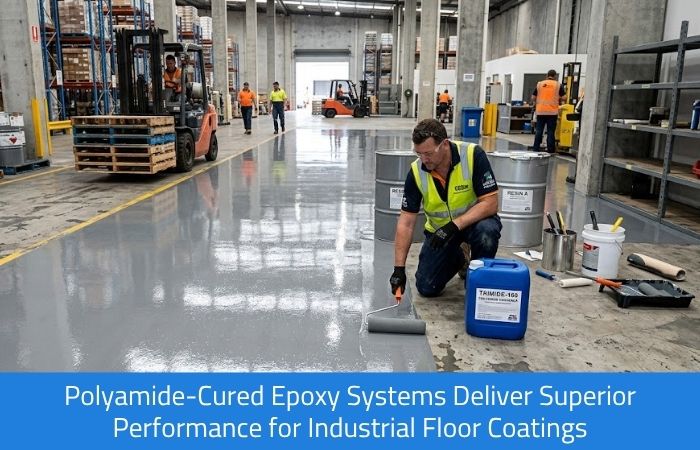
Industrial floors take a beating. Between forklift traffic, chemical spills and continuous foot movement, the coating system holding everything together needs to perform at a level that standard paint simply cannot match. At the centre of that performance is one critical variable – the epoxy hardener. Choosing the right curing agent determines not just how the floor looks on day one, but how it holds up across years of service.
Two systems dominate industrial floor coating chemistry: amine-cured and polyamide-cured epoxies. While both are widely used, the gap in real-world performance is significant. This article explains why polyamide-cured systems consistently deliver better outcomes in flooring applications and how Trimide-160 – a reactive polyamide resin – represents this advantage in practice.
Epoxy Hardener Chemistry: What Actually Changes at the Molecular Level
An epoxy hardener does more than simply “cure” a resin. It cross-links with the epoxy molecules to form a three-dimensional network and the density, flexibility and chemistry of that network depends directly on the type of hardener used.
Amine-cured systems use either aliphatic or aromatic amines as the reactive agent. These produce fast, rigid cross-links – which can be useful in some structural applications, but become a liability on floors. The resulting film tends to be brittle, prone to surface blushing in humid conditions and sensitive to application temperature. On top of that, amine-cured coatings often require precise mixing ratios and any deviation can cause soft spots or adhesion failure.
Polyamide-cured systems work differently. A reactive polyamide resin reacts with the epoxy through amine groups present in its backbone, but the polyamide structure itself introduces longer chain segments between cross-links. This produces a network that is tougher, more flexible and significantly more resistant to impact and abrasion – exactly what industrial floors demand.
Abrasion Resistance: Where Polyamide-Cured Systems Pull Ahead
Abrasion resistance is arguably the most important mechanical property for any floor coating. Constant traffic from wheeled equipment, dragged materials and foot movement wears down coatings over time and a system that fails here fails completely.
Epoxy hardeners based on polyamide chemistry show measurably superior abrasion resistance compared to standard amine alternatives. The reason lies in the flexible chain structure of the cured film. Rather than fracturing under repeated stress, the polyamide-cured network absorbs and distributes that energy – resisting surface wear instead of yielding to it.
Trimide-160 is formulated for precisely this kind of demanding service. As a high-build epoxy polyamide coating hardener, it enables film builds that maintain integrity under continuous mechanical load. The cured surface resists both sliding abrasion from foot traffic and rolling abrasion from wheeled equipment, without the micro-cracking that limits amine-cured systems in the same conditions.
Open Time and Application Control in Industrial Flooring
Open time – the window during which a mixed epoxy system remains workable – has a direct impact on application quality, especially on large floor areas. Amine-cured reactive resins typically have short pot lives that place significant pressure on application teams. Once mixed, these systems begin to build viscosity quickly, making even coverage difficult and leading to visible lap marks or uneven film thickness.
Reactive polyamide systems offer a longer, more forgiving open time. This is not simply a convenience – it directly affects the quality of the finished floor. Applicators have time to spread material evenly, work edges properly and address any coverage gaps before the window closes.
Trimide-160 provides consistent working time that suits large-scale industrial floor applications. Its formulation supports controlled application without the rushed technique that short-pot-life systems demand, reducing the risk of application errors that lead to premature coating failure.
Self-Levelling Performance: Why Hardener Choice Matters
Self-levelling epoxy floor coatings are valued for producing smooth, seamless surfaces with minimal surface preparation defects showing through. But achieving true self-levelling behaviour depends heavily on the viscosity profile of the mixed system – which is shaped significantly by the epoxy hardener selected.
Amine-cured systems can be difficult to balance here. Their fast reactivity means viscosity rises quickly after mixing, limiting flow and levelling before the coating has had time to settle. The result is often a surface that shows brush marks, roller stipple or uneven texture rather than the flat, mirror-like finish that self-levelling floors are specified to achieve.
Trimide-160 supports genuine self-levelling behaviour. Its viscosity profile as a reactive resin allows the mixed system to flow and settle before the cure progresses to a point where movement stops. Combined with its compatibility in high-build formulations, this makes it a practical choice for flooring systems where a uniform, defect-free surface is required – whether in industrial production facilities, warehouses or commercial spaces requiring seamless hygiene-compliant floors.
Epoxy Hardner: Adhesion, Moisture Tolerance and Long-Term Film Integrity
One of the persistent weaknesses of amine-cured epoxy hardners in flooring is moisture sensitivity. Amine blush – a waxy, whitish surface deposit caused by the reaction of amine groups with atmospheric moisture and carbon dioxide – is a known problem with these systems. It compromises intercoat adhesion, dulls the finish and can cause delamination if not addressed between coats.
Polyamide-cured systems are substantially more tolerant of ambient humidity during application and curing. The polyamide backbone is less reactive toward atmospheric moisture than free amine groups, which means a cleaner cure, better surface appearance and stronger intercoat bond – even in less-than-ideal environmental conditions.
For flooring applications where temperature and humidity may be difficult to control – active manufacturing plants, food processing areas, below-grade spaces – this moisture tolerance is a significant practical advantage. Trimide-160’s performance in these conditions reflects the inherent chemistry of reactive polyamide resins, not just formulation work.
Our Other Products
Phenolic ResinVersatility Across Flooring System Types
Trimide-160 is not limited to a single floor coating format. Its application range spans high-build coatings, tile grout systems and casting and potting applications – making it useful across the full spectrum of floor construction and repair work.
In tile grout applications, the toughness and chemical resistance of a polyamide-cured epoxy hardener outperforms cement-based alternatives. The grout resists staining, withstands cleaning chemicals and remains mechanically intact under thermal cycling – properties that matter in commercial kitchens, pharmaceutical manufacturing and food production environments.
In casting and potting applications relevant to floor construction – such as anchoring systems, joint filling and surface levelling compounds – the controlled cure and good adhesion of Trimide-160 provide reliable results across a range of substrates including concrete, steel and timber.
Why Polyamide-Cured Epoxy Systems Make Practical Sense for Flooring Specifiers
When specifiers and applicators evaluate epoxy hardeners for industrial floor coatings, the real question is not which system looks best on a data sheet – it is which system performs reliably across the full range of conditions a working floor encounters.
Polyamide-cured systems, with their superior abrasion resistance, extended open time, genuine self-levelling capability and moisture tolerance, address the specific demands of floor coating in ways that standard amine-cured reactive resins do not. Trimide-160 delivers these properties in a formulation designed for high-build floor and encapsulation systems, giving applicators a hardener that performs across a broad range of flooring projects without the compromises that limit amine alternatives.
For industrial floor coatings where long-term performance, finish quality and application reliability all matter, the chemistry points clearly toward polyamide – and Trimide-160 is where that chemistry is put to practical use.
Conclusion
When performance and durability are non-negotiable, the choice of epoxy hardener defines the outcome of any industrial floor coating system. Polyamide-cured systems address every challenge that amine-cured reactive resins fall short on – from abrasion resistance and open time to self-levelling behaviour and moisture tolerance. Its consistent reactivity and broad substrate compatibility make it a dependable choice for specifiers and applicators who cannot afford coating failure on a live industrial floor. As epoxy hardener technology advances, polyamide chemistry remains the benchmark where toughness and finish quality must coexist.
- Phenolic Resin Manufacturing Process: From Raw Material to Finished Product
- Questions to Ask a Phenolic Resin Manufacturer Before Placing an Order
- Alkyl Phenol Formaldehyde Resins Market Demand in Asia and Middle East
- Alkyl Phenol Formaldehyde Resin vs Conventional Phenolic Resin
- What Is Alkyl Phenol Formaldehyde Resin and Where Is It Used