


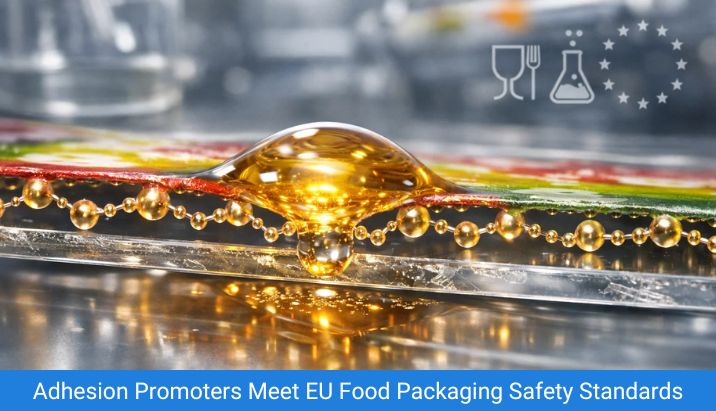
GIO 2026 Compliance: Adhesion Promoters for Food Packaging Inks
The landscape of global food packaging is undergoing its most significant regulatory shift in a decade. As of January 1, 2026, the German Printing Ink Ordinance (GIO)-formally the 21st Amendment to the Consumer Goods Ordinance-has become fully mandatory. For manufacturers and exporters in Russia, Uzbekistan, and across Europe, this is no longer a “future requirement” but a critical gatekeeper for entering the European Union’s largest economy.
In this new era, “standard” chemical additives are being replaced by high-purity, technically validated solutions. Central to this transition is the role of adhesion promoters. For the discerning exporter, Tridev Group’s TA-10 Adhesion Promoter has emerged as the definitive safety choice, combining unmatched chemical bonding with a high-purity profile designed specifically for 2026 compliance.
Read Our Article: Choosing the Right Adhesion Promoter: Quality Parameters to Consider
The GIO 2026 Challenge: From “Reference” to “Regulation”
For years, the industry relied on a patchwork of national rules and the Swiss Ordinance as a benchmark. However, the German Printing Ink Ordinance (GIO) sets a more rigorous standard. Its primary objective is the protection of consumer health by strictly regulating the migration of substances from packaging into food.
The Positive List Principle
The GIO operates on a “Positive List” principle. Only substances listed in the ordinance’s annexes-monomers, additives, photoinitiators, and solvents-are permitted for use in printing inks and varnishes intended for food packaging. Any unlisted substance must undergo a rigorous risk assessment to prove that its migration does not exceed 0.01 mg/kg (10 ppb).
Beyond Direct Contact
Crucially, the GIO covers both direct and indirect food contact. This means that even if the ink is printed on the outside of a multi-layer pouch, the manufacturer must ensure that substances do not “set off” or migrate through the substrate layers into the foodstuff. For exporters in Uzbekistan and Russia, failing to meet these standards doesn’t just mean a fine; it means the total rejection of goods at the EU border.

Technical Authority: The Purity and Performance of TA-10
In a regulatory environment defined by migration limits, the purity of your raw materials is your best defense. This is where Tridev’s TA-10-a high-purity Titanium-based Adhesion Promoter-provides a decisive advantage.
The Power of 8.6% Titanium Concentration
While “economy” promoters often vary in their active content, TA-10 is engineered with a specific, high-purity titanium concentration of 8.4% to 8.6%. This precise concentration is not just a mark of quality; it is a strategic tool for compliance.
- Lower Dosage Levels: Due to the high active content, ink formulators can achieve superior bond strength with a significantly lower dosage of the additive. In the world of migration testing, a lower initial concentration of an additive in the ink film dramatically reduces the mathematical risk of exceeding migration thresholds.
- Superior Cross-Linking: The organometallic structure of TA-10 allows for high-efficiency cross-linking between the ink resin and the non-polar substrate (BOPP, PET, or PE). This creates a stable, chemically bonded matrix that “locks” the ink in place, preventing the diffusion of ink components.
Our Other Products: Polyurethane Resin
Minimizing Migration Risk for Exporters
For exporters in Russia and Uzbekistan, the GIO represents a “transparency test.” EU brand owners now demand a Statement of Composition (SoC) and a Declaration of Compliance (DoC) for every batch of printed packaging.
Achieving the 10 ppb Standard
By using a high-titanium promoter like TA-10, manufacturers can comfortably meet the 0.01 mg/kg non-detectable migration limit. Because TA-10 forms covalent bonds with the substrate, it becomes a permanent part of the solid ink film rather than remaining as a “migratable” free molecule. This chemical anchoring is essential for packaging that undergoes sterilization or long-term shelf storage.
Eliminating NIAS Concerns
Non-Intentionally Added Substances (NIAS) are a major focus of GIO audits. Tridev Group’s manufacturing process for TA-10 is governed by Good Manufacturing Practices (GMP), ensuring that there are no unlisted impurities or heavy metal contaminants that could trigger a migration failure during a lab audit in Germany.
Market Impact: Why Uzbekistan and Russia Must Adapt Now
The GIO is a national German law, but its impact is continental. Because of the Mutual Recognition principle and the complexity of supply chains, most European converters are adopting the GIO as their “House Standard.”
- For Uzbekistani Converters: As Uzbekistan expands its role as a regional packaging hub for agricultural exports to Europe, compliance with GIO-listed additives like TA-10 is the key to securing long-term contracts with EU retailers.
- For Russian Ink Manufacturers: The shift toward local production means that sourcing high-quality, compliant adhesion promoters is vital for supporting the domestic food packaging industry’s export ambitions.

Strategic Conclusion: Safety is the New Competitive Advantage
In 2026, the competition in the printing ink market is no longer fought on price alone; it is fought on validation. A cheaper adhesion promoter that results in a migration failure is the most expensive mistake a company can make.
Tridev Group’s TA-10 offers a strategic roadmap for GIO compliance. By providing high active titanium content and a clean toxicological profile, it allows manufacturers to formulate inks that are both high-performing and “EU-Ready.” For the global exporter, TA-10 is more than an additive-it is a certificate of safety that opens the door to the most lucrative markets in the world.
Read Our Article: What is an Adhesion Promoter? Types, Properties and Applications
Comparison of Regulatory Alignment: TA-10 vs. Standard Promoters
| Feature | Standard Adhesion Promoters | Tridev TA-10 (GIO Grade) |
| Titanium Active Content | Variable (often less than 7%) | High Purity (8.4% – 8.6%) |
| Dosage Required | High (increasing migration risk) | Ultra-Low (minimizing risk) |
| GIO Positive List | Uncertain / Evaluated in-part | Fully Aligned / GMP Manufactured |
| Substrate Bonding | Physical adhesion | Chemical Covalent Anchoring |
| Export Readiness | High risk of EU border rejection | Validated for EU Food Contact |
- PVB Resin for Structural & Hot-Melt Adhesives in Saudi Arabia’s Construction
- PVB Resin Demand in Brazil’s Furniture Coatings Industry
- PVB Resin for Etch Primers in Lebanon’s Construction Sector
- PVB Resin in Etch Primers for Peru Mining & Heavy Equipment
- PVB Resin for Etch Primers in Mexico’s Automotive Industry