


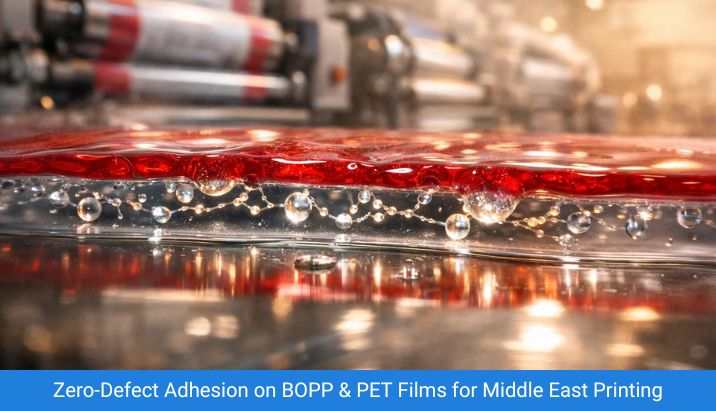
Heat Challenges in High-Speed Flexo Printing in the Middle East
In the rapidly expanding logistics and packaging hubs of Dubai and Saudi Arabia, high-speed flexo presses often push the limits of performance, reaching speeds of 600+ meters per minute. However, the Middle Eastern climate introduces a unique adversary: extreme ambient heat. For ink formulators and printers, this heat triggers a cascade of technical challenges-most notably heat-induced viscosity drops and ink misting-that can lead to catastrophic delamination on non-polar substrates like BOPP and PET.
Our Other Product: Fumaric Resin
The Problem: Heat-Induced Viscosity and the ‘Misting’ Effect
In extreme climates, high temperatures cause the solvent-based ink’s viscosity to plummet. When viscosity falls below the critical threshold, the ink loses its structural integrity. At high press speeds, this results in:
- Ink Misting: Centrifugal forces at the anilox and plate rollers “sling” low-viscosity ink into the air, creating a fine mist that contaminates the machinery and the print area.
- Poor Wet-Out: The ink becomes too fluid to “anchor” correctly, leading to uneven laydown and “pinholing” on low-surface-energy films.
- Ink Pick-Up: During high-speed rewinding, the unstable ink film may “pick up” or transfer to the back of the substrate, ruining the entire roll.
Read Our Article: How Adhesion Promoters are Transforming Print Quality in Peru’s Flexographic Sector?
Technical Authority: The TPI-02 Advantage
To combat these challenges, Tridev Group has engineered the TPI-02 Adhesion Promoter, specifically optimized for high-performance flexo inks and overprint varnishes (OPV).
The success of TPI-02 in extreme climates lies in its stabilized viscosity (16 to 18 seconds via FCB4) and its high active Titanium content (8.4% to 8.6%).
Maintaining Viscosity Stability
While heat naturally thins resins, the TPI-02 organometallic complex acts as a rheological stabilizer. It ensures the ink maintains a consistent “body,” preventing the dramatic thinning that leads to misting. By keeping the viscosity within the 16 to 18 second range, TPI-02 ensures:
- Controlled Ink Transfer: Smooth and uniform transfer from the anilox cells to the plate.
- Reduced Dot Gain: Sharper image reproduction even as press temperatures rise.
Covalent Molecular Anchoring
TPI-02 doesn’t just “sit” on the film; it creates a chemical bridge. The titanium centers in TPI-02 form covalent bonds with the functional groups on the surface of corona-treated BOPP and PET. This molecular “hook” is heat-resistant, ensuring that the bond doesn’t weaken even if the substrate remains warm during the rewinding process.
Our Other Product: Non Reactive Polyamide Resin

Performance Comparison in High-Heat Environments
| Feature | Standard Adhesion Promoters | Tridev TPI-02 |
| Viscosity at High Temp | Drops rapidly (less than 12 sec) | Stabilized (16 to 18 sec) |
| High-Speed Misting | High risk of contamination | Minimal to zero misting |
| Adhesion Mechanism | Physical Van der Waals force | Covalent Chemical Bonding |
| Rewind Performance | High risk of ink pick-up | Secure “Zero-Defect” bonding |
Read Our Article: Formulation Tips for Adhesion Promoter: Balancing Titanium Content and Viscosity in Flexo Ink Systems
Conclusion: The Strategic Choice for Middle Eastern Hubs
For printers in the UAE and Saudi Arabia, TPI-02 is more than an additive; it is a performance insurance policy. By stabilizing ink rheology and providing unyielding chemical adhesion, TPI-02 allows for maximum press speeds without the fear of climate-induced defects.
- PVB Resin for Structural & Hot-Melt Adhesives in Saudi Arabia’s Construction
- PVB Resin Demand in Brazil’s Furniture Coatings Industry
- PVB Resin for Etch Primers in Lebanon’s Construction Sector
- PVB Resin in Etch Primers for Peru Mining & Heavy Equipment
- PVB Resin for Etch Primers in Mexico’s Automotive Industry