


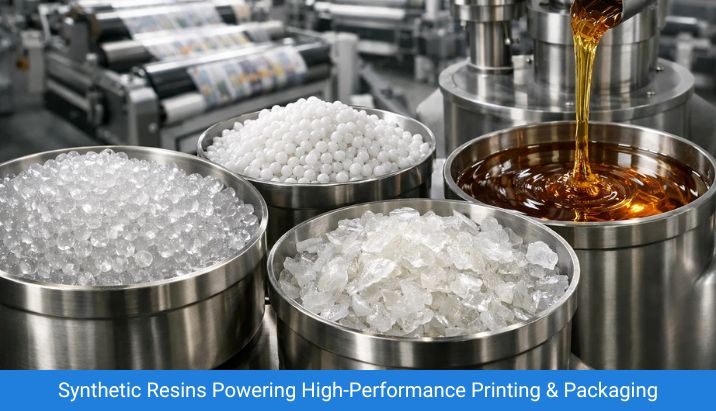
Strategic Resin Choices Driving Global Printing & Packaging Advancements in 2026
In the fast-evolving world of global commerce, the synergy between material science and logistics has become the ultimate competitive advantage. For manufacturers, traders, and distributors in the printing and packaging sectors, the choice of resin is no longer just a technical detail-it is a strategic decision that impacts everything from supply chain speed in Dubai to retail shelf appeal in Mexico.
As we look toward the industrial demands of 2026, four key markets-Dubai, Indonesia, Mexico, and Egypt-are emerging as hubs for specialized ink applications. By leveraging the unique properties of Synthetic Ketonic Resins, Rosin Modified Resins, and Polyurethane Resins, these regions are setting new benchmarks for high-performance printing and packaging.
Read Our Article: Synthetic Resins Opportunities in Saudi Arabia, Russia, Uzbekistan, and South Africa
The Dubai Logistics Hub: Powering High-Speed Distribution with Synthetic Ketonic Resins
Dubai has solidified its position as the “Crossroads of the World,” serving as the primary logistics and distribution artery for Europe, Asia, and Africa. In this high-velocity environment, packaging is subjected to extreme mechanical stress and rapid automated sorting.
The Essential Role of Synthetic Ketonic Resins
For flexographic inks used in Dubai’s massive fulfillment centers, Synthetic Ketonic Resins (such as HK-100 and HK-1000) are indispensable. These resins provide the “backbone” for inks that must perform under the high-pressure conditions of modern distribution.
- Superior Adhesion for Global Transit: Dubai handles a vast array of substrates, from high-density polyethylene (HDPE) bags to corrugated shipping containers. Ketonic resins ensure that barcodes and tracking information remain crisp and readable, preventing ink flaking or smudging during long-haul transit.
- High-Speed Print Compatibility: Modern flexo presses in the UAE operate at speeds exceeding 600 meters per minute. The low melt viscosity of ketonic resins allows for even ink laydown at these speeds, ensuring consistent coverage without the risk of “nozzle clogging” or print defects.
- Thermal Stability: In the intense heat of Middle Eastern warehouses, where temperatures can fluctuate significantly, ketonic resins provide the necessary thermal resistance to prevent “blocking” (where stacked packages stick together).

Our Other Products: Polyvinyl Butyral Resin
Indonesia’s Booming E-commerce: Rosin Modified Resins and the Quest for Gloss
Indonesia is currently home to one of the fastest-growing e-commerce markets in the world. As millions of consumers shift toward online shopping, the demand for primary and secondary packaging that combines “ruggedness” with “premium aesthetics” has skyrocketed.
Driving the Demand for High-Gloss Inks
In the Indonesian market, Rosin Modified Phenolic Resins are the preferred choice for converters looking to balance cost-efficiency with high-end visual appeal.
- Enhanced Tack and Bonding: E-commerce packaging often utilizes recycled paper and varied plastic films. Rosin modified resins act as powerful tackifiers, ensuring that the ink bonds instantly to the substrate, which is crucial for high-speed “form-fill-seal” operations.
- Unrivaled Gloss and Clarity: Indonesian brands are increasingly focusing on “unboxing experiences.” Rosin modified resins impart a high-gloss finish to packaging inks, making colors appear more vibrant and giving corrugated boxes a premium, high-quality feel.
- Ink Stability in High Humidity: Indonesia’s tropical climate presents a major challenge for ink drying and stability. Modified rosins enhance the ink’s resistance to moisture, preventing smudging or fading in high-humidity storage conditions.
Read Our Article: Synthetic Resins 2026: Market Trends & Strategic Insights for Global Distributors
The “No-Label” Trend in Mexico: Polyurethane Resins for the Beverage Elite
Mexico’s beverage sector-led by its globally famous beer, tequila, and mezcal exports-is undergoing a visual revolution. The “No-Label” look, where graphics appear printed directly onto the bottle, has become the gold standard for premium branding.
The Polyurethane Advantage in High-Clarity Labeling
Achieving the “No-Label” look requires transparent labels that are virtually invisible. Polyurethane (PU) Resins are the enabling technology behind this aesthetic.
- Exceptional Transparency and Clarity: PU resins are used to formulate high-clarity adhesives and coatings for PET and glass labels. Unlike other resins that may yellow over time, PU maintains a crystal-clear finish that allows the product’s natural color to take center stage.
- Flexibility and “Squeeze” Resistance: Many Mexican beverages are packaged in flexible plastic containers. PU resins offer the elasticity needed for the label to flex with the bottle without cracking or delaminating.
- Water and Alcohol Resistance: For the beverage industry, labels must withstand “ice bucket” immersion and occasional alcohol spills. PU-based inks and adhesives provide a robust barrier that ensures the label remains intact and pristine in social environments.
Optimizing Drying Times: Ketonic Resins in Egypt’s Commercial Printing Sector
Egypt is rapidly expanding its commercial printing and flexible packaging capacity to serve both its large domestic population and its growing export markets in the Mediterranean and North Africa. In this competitive landscape, production throughput is the primary KPI.
Why Egypt Prefers Synthetic Ketonic Resins
The Egyptian printing industry has identified Synthetic Ketonic Resins as the most cost-effective way to optimize drying cycles and reduce energy consumption.
- Rapid Solvent Release: Ketonic resins are known for their “fast-dry” properties. In Egypt’s fast-paced commercial printing shops, this allows for immediate post-print processing (such as cutting or folding), significantly reducing lead times.
- Improved Pigment Wetting: Achieving deep, saturated blacks and vibrant reds is essential for the Egyptian textile and food packaging markets. Ketonic resins offer excellent pigment wetting, allowing manufacturers to achieve higher color density with less ink.
- Compatibility with Alcohol-Based Systems: As Egypt moves toward more eco-friendly, low-VOC printing environments, the high solubility of ketonic resins in ethanol and propanol makes them the ideal choice for modern, alcohol-based ink systems.

Our Other Products: Adhesion Promoter
Summary of Regional Resin Applications (2026)
| Region | Primary Driver | Dominant Resin Choice | Key Performance Metric |
| Dubai (UAE) | Global Logistics | Ketonic Resin | Adhesion & High-Speed Flow |
| Indonesia | E-commerce Growth | Rosin Modified | High Gloss & Tack |
| Mexico | Premium Beverages | Polyurethane | Clarity & Flexibility |
| Egypt | Production Volume | Ketonic Resin | Fast Drying & Color Density |
Conclusion: The Future is Specialized
As we move further into 2026, the global printing and packaging industry is no longer satisfied with “general purpose” solutions. The success of a distributor or a manufacturer depends on their ability to match the specific industrial demands of a region with the correct resin chemistry.
From the high-speed hubs of Dubai to the clear, premium labels of Mexico, synthetic resins are the invisible force driving packaging innovation. By choosing the right binder-whether it be the rapid-drying Ketonic, the high-gloss Rosin Modified, or the ultra-clear Polyurethane-brands can ensure their products are not just protected, but also perfectly presented to the global consumer.
- PAINTINDIA 2026: Innovating the Future of Coating Technologies
- How the Indian Specialty Chemical Sector Navigated the 2025 US Tariff Crisis
- Synthetic Resin & Polymer Industry: From 2025 US Tariff Crisis to 2026 EU–India FTA
- Synthetic Resins for High-Performance Printing & Packaging: Reshaping the Global Ink Landscape
- Why Tridev’s Adhesion Promoters are the Safety Choice for EU Food Packaging Exporters? – Navigating the 2026 German Printing Ink Ordinance