


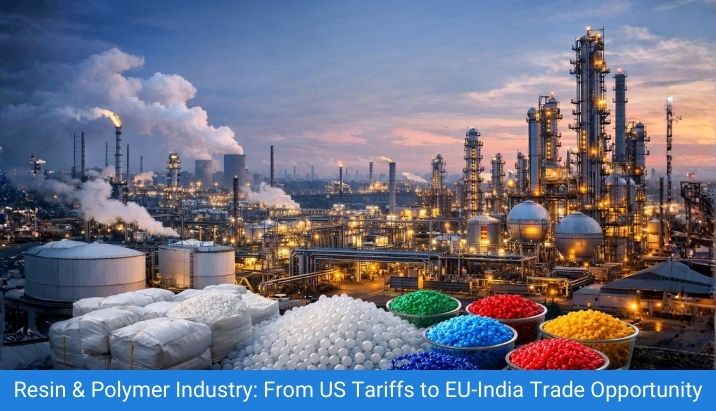
Resin & Polymer Sector: Trade Shifts from 2025 to 2026
The global chemical landscape of 2025 and 2026 has been defined by two seismic shifts. For manufacturers of specialty resins and polymers, the environment transformed overnight when a series of aggressive US tariff hikes created a 50% trade wall in late 2025. However, this period of volatility was followed by a historic breakthrough: the signing of the January 2026 EU-India Free Trade Agreement (FTA).
For Tridev Resins Pvt Ltd, based in the industrial heart of Valsad, Gujarat, these events have served as a catalyst for global diversification. By pivoting toward the European market and leveraging the new zero-duty framework, Tridev Resins has emerged as a premier partner for the international coatings, printing, and adhesive industries.
Navigating the 2025 US Tariff Shock
In August 2025, the US administration implemented broad reciprocal tariffs that peaked at 50% for most Indian engineering and chemical exports. For the specialty resin sector, the impact was significant.
High-performance products ranging from Synthetic Ketonic Resins to UV Oligomers suddenly faced a steep price disadvantage in the American market. This “tariff wall” forced Indian manufacturers to accelerate their search for more stable and reciprocal trade partnerships, ultimately setting the stage for a strategic pivot toward the European Union.
The 2026 FTA: A Zero-Duty Gateway to Europe
The finalization of the EU-India FTA on January 27, 2026, has completely recalibrated the competitive landscape. Frequently hailed as a transformative deal for the chemical industry, the agreement provides immediate and phased advantages for Tridev Resins’ entire portfolio.
Immediate Tariff Elimination
Under the new deal, the EU has eliminated tariffs on over 99% of Indian chemical exports. For specialized products like Polyvinyl Butyral (PVB) Resin and Polyamide Resins, which previously faced duties of 4% to 6.5%, the tariff has dropped to 0%. This makes Indian-manufactured resins the most cost-effective high-quality option for European formulators.
Standards and Regulatory Synergy
A critical pillar of the 2026 agreement is regulatory cooperation. By aligning Indian manufacturing standards with EU benchmarks like REACH, the FTA simplifies the certification process. Tridev Resins, with its state-of-the-art infrastructure in Valsad and Dahej, is already positioned to meet these stringent environmental and safety requirements, ensuring a seamless supply chain for European clients.
Strategic Product Impact: Strengthening European Industries
Tridev Resins offers a comprehensive range of synthetic resins designed to enhance the performance of European industrial applications.
- Printing and Packaging: Synthetic Ketonic Resin and PVB Resin are essential for high-gloss, fast-drying inks. The FTA allows European ink manufacturers to source these high-purity binders with zero import duty.
- Coatings and Adhesives: Our Reactive and Non-Reactive Polyamide Resins, alongside Polyurethane Resins, provide the durability and flexibility required by the European automotive and construction sectors.
- Eco-Friendly Solutions: To meet the EU’s Green Deal objectives, Tridev Resins offers Water-Base Acrylic Emulsions and UV Oligomers. These low-VOC and radiation-curable systems allow European manufacturers to maintain high performance while reducing their environmental footprint.
- Modified Natural Resins: Our range of Rosin Modified Maleic, Phenolic, and Ester Gums provides the bio-based chemical backbone necessary for sustainable hot-melt adhesives and varnishes.
The Tridev Resin Advantage: Quality Engineered in Valsad
With an output potential of 17,000 MTPA across three production facilities, Tridev Resins Pvt Ltd combines massive manufacturing scale with precision chemistry.
| Feature | Strategic Advantage for Europe |
| Manufacturing Scale | Combined 32,000 m² factory area with advanced reactor series. |
| Strategic Location | Proximity to major sea ports like Hazira and Dahej for rapid shipping. |
| R&D Excellence | Dedicated pilot reactors and research scientists for custom formulations. |
| Consistency | Round-the-clock QC labs testing for viscosity, acid value, and softening points. |
By utilizing the self-certification rules under the 2026 FTA, Tridev Resins provides European importers with a faster, more transparent customs experience, effectively bridging the distance between Gujarat and the European continent.
Conclusion: A Partnership for a Borderless Economy
Resin & Polymers: Navigating Tariffs and Trade Agreements
The trade shifts of 2025 and 2026 have proven that the future of the chemical industry lies in diversification and high-quality partnerships. Tridev Resins Pvt Ltd has not only survived the challenges of protectionism but has flourished by embracing the opportunities of the new EU-India trade corridor.
For European procurement managers seeking reliability, innovation, and unmatched value, Tridev Resins stands ready as a strategic partner. Our commitment to global standards and our heritage of engineering excellence ensure that we deliver the bonding agents for a more successful and sustainable global economy.
- PAINTINDIA 2026: Innovating the Future of Coating Technologies
- How the Indian Specialty Chemical Sector Navigated the 2025 US Tariff Crisis
- Synthetic Resin & Polymer Industry: From 2025 US Tariff Crisis to 2026 EU–India FTA
- Synthetic Resins for High-Performance Printing & Packaging: Reshaping the Global Ink Landscape
- Why Tridev’s Adhesion Promoters are the Safety Choice for EU Food Packaging Exporters? – Navigating the 2026 German Printing Ink Ordinance