


AI Summary
To explain in clear, professional and technical language how Phenolic Resins manufacturers across the world are establishing new quality benchmarks through improved formulation control, testing accuracy and production consistency, focusing on Phenolic Resin for Adhesive, Laminate and Epoxy applications.
Introduction:
The world of polymer chemistry constantly evolves and Phenolic Resin remains one of the most technically consistent thermosetting materials used across industries. It serves as a foundation for adhesives, coatings, laminates and molding compounds. Its stability, heat resistance and strong bonding properties make it integral to automotive, electrical and construction sectors.
As demand rises in countries such as India, Germany, Japan and the United States, Phenolic Resin manufacturers are setting new global quality benchmarks. These benchmarks are defined through tighter specifications, reproducible curing behavior and enhanced testing protocols. Whether used in adhesives, laminates, coatings or epoxy systems, each production batch must meet strict tolerances related to viscosity, molecular structure, acid value and melting range.
This article explores how these manufacturers maintain consistency, ensure purity and control formulation accuracy – creating a shared global language for resin quality.

Phenolic Resin for Adhesive: Defining New Quality Parameters
In the adhesive sector, Phenolic Resin for Adhesive formulations form a core component in wood bonding, brake linings and industrial composites. Manufacturers define precise benchmarks related to viscosity, gel time and free phenol content to ensure uniform curing and bond strength.
Global producers, including those in Europe and Asia, use advanced polymerization control methods to stabilize resin reactivity. Continuous monitoring of the ratio ensures that the final resin achieves a consistent molecular weight.
By keeping these parameters uniform, manufacturers ensure that the phenolic resin adhesive exhibits predictable performance under varied temperature and humidity conditions. These tight controls also align with international industrial standards, which promote a unified approach to measuring resin performance worldwide.
Read Our Article: How Melting Range Control Ensures Phenolic Resins Performance Stability in Printing Applications?
Phenolic Resin Epoxy: Establishing Reliable Crosslinking Behavior
For hybrid systems, phenolic resin epoxy formulations require precise control of crosslink density. Manufacturers focus on maintaining a balanced ratio between phenolic hydroxyl groups and epoxy equivalents, ensuring uniform curing.
Across advanced facilities in countries such as Japan, Germany and South Korea, in-line sensors and thermal analysis systems track polymerization reactions in real time. These methods ensure that epoxy–phenolic blends achieve the same hardness, adhesion and thermal stability across multiple production plants.
Quality benchmarks also include post-cure shrinkage measurements and residual solvent analysis. By doing so, manufacturers standardize their output, ensuring consistent resin networks that can be trusted across various applications, from coatings to high-friction components.
Phenolic Resin Material: Standardizing Molecular Design and Testing
The foundation of every application lies in the Phenolic Resin material itself. Global manufacturers now employ molecular-level control to achieve reproducible results.
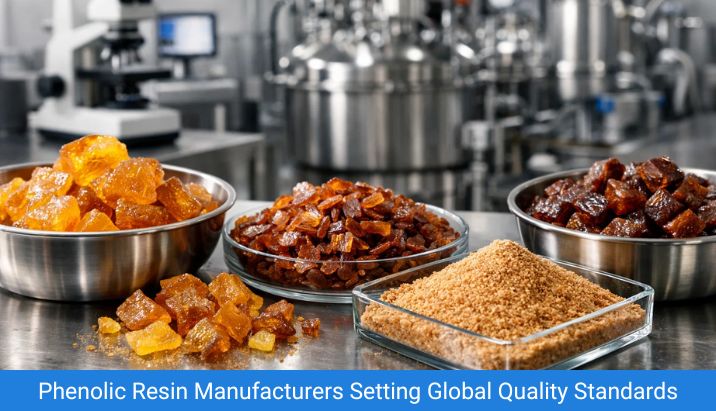
The melting range, acid value and density of the resin are tightly controlled during production. For instance, resins intended for coatings and inks are produced in pale yellow to brown lumps with melting points ranging from 68°C to 105°C, depending on end use. Manufacturers conduct multiple-stage purification to reduce free phenol, which enhances stability and ensures cleaner curing profiles.
Quality control laboratories test each batch for molecular weight distribution (via GPC), moisture (via Karl Fischer titration) and gel time consistency. This data-driven approach ensures that each Phenolic Resin material meets the precise requirements for adhesives, coatings and laminates, maintaining uniformity across international markets.
Our Other Products: Titanium Acetylacetonate Chelate
Phenolic Resin Use: Achieving Consistency in Industrial Applications
The phenolic resin use spectrum includes coatings, adhesives, varnishes and molding compounds. Regardless of the application, manufacturers maintain globally aligned standards that may include cure temperature consistency, bonding strength verification and batch-to-batch viscosity control.
In industrial plants across India, Germany and Brazil, teams use the same analytical reference charts and calibration samples to ensure identical test results. The result is a predictable and controlled resin performance that allows engineers and chemists to design systems with repeatable curing, color stability and mechanical strength.
Every lot is accompanied by a certificate of analysis detailing parameters such as moisture percentage, solid content and gel time – making traceability a built-in part of the production process.
Phenolic Resin Price and Quality Correlation
Although the phenolic resin price can vary depending on formulation type and purity, it is often closely linked with the degree of process control and laboratory validation. Premium grades undergo deeper analysis and longer polymerization cycles to guarantee molecular uniformity.
Manufacturers maintain cost efficiency while ensuring that no compromise is made on test precision. The correlation between analytical intensity and pricing allows customers to understand what quality tier they are purchasing. Whether in Europe, Japan or India, the same criteria for quality evaluation apply, creating a balanced market understanding of what defines a high-quality phenolic resin.
Read Our Article: Role of Phenolic Resins in Paints, Overprint Varnish, and Shoe Polish
Buy Phenolic Resin: Global Standards in Procurement Specifications
When engineers or formulators buy phenolic resin, they often rely on standard technical specifications that define measurable properties rather than brand-based descriptions.
Manufacturers worldwide maintain specifications that include F/P ratio tolerances, viscosity range at given temperatures and gel-time limits. These details are presented in technical data sheets (TDS) and verified by independent testing. By aligning procurement specifications globally, industries ensure that resins sourced from different countries can be used interchangeably without compromising performance or process safety.
This transparency builds confidence among users and ensures that every purchase aligns with internationally recognized quality benchmarks.
Use of Phenolic Resin in Coatings and Inks: Maintaining Benchmark Uniformity
In coatings and printing ink industries, use of phenolic resin requires steady adhesion, clarity and thermal stability. Manufacturers regulate the resin’s viscosity and acid value to match application requirements.
Resins with melting ranges between 68°C and 105°C are particularly suited for paints, overprint varnishes and deep-freeze printing inks. Global producers maintain identical melting range control to ensure print quality consistency and smooth finish during ink application.
For example, a Phenolic Resin for Adhesive used in high-performance varnishes may share analytical fingerprints with a resin used in printing ink bases, provided both are synthesized under similar process parameters. This level of alignment represents a major step forward in establishing new global quality benchmarks for the coating and ink industries.

Phenolic Resin: Precision, Purity and Global Process Harmony
From Europe’s advanced production lines to Asia’s large-scale plants, Phenolic Resin manufacturing has become a science of precision. Global producers integrate continuous monitoring, digital process control and standard analytical validation. They may implement AI-assisted reaction tracking to predict viscosity drifts and molecular changes in real time.
Through harmonized process documentation and test calibration, the resin’s quality remains steady regardless of where it is made. These practices reflect a worldwide movement toward measurable, reproducible and traceable production – hallmarks of next-generation quality benchmarking.
Our Other Products: Fumaric Resin
Conclusion:
Phenolic Resin manufacturers are not just producing material; they are defining what “quality” means on a global scale. Through structured testing, real-time monitoring and standardized documentation, they create a shared international benchmark for adhesives, laminates, coatings and epoxy systems.
- PAINTINDIA 2026: Innovating the Future of Coating Technologies
- How the Indian Specialty Chemical Sector Navigated the 2025 US Tariff Crisis
- Synthetic Resin & Polymer Industry: From 2025 US Tariff Crisis to 2026 EU–India FTA
- Synthetic Resins for High-Performance Printing & Packaging: Reshaping the Global Ink Landscape
- Why Tridev’s Adhesion Promoters are the Safety Choice for EU Food Packaging Exporters? – Navigating the 2026 German Printing Ink Ordinance