


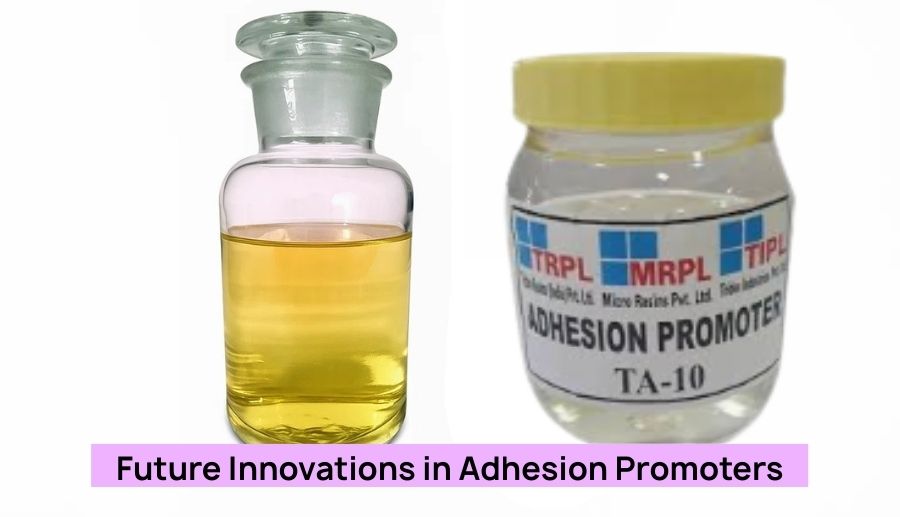
As industrial materials and surfaces continue to evolve, so too must the technologies that enable them to bond reliably. The adhesion promoter – a critical additive in coatings, inks and adhesives – has become a focal point for innovation as industries demand higher performance, better substrate compatibility and increased durability. In 2025 and the years ahead, cutting-edge developments in formulation science, nanotechnology and surface chemistry are reshaping what these materials can do. From improving superior adhesion in challenging environments to enabling smarter interface behavior, the future of adhesion promoters is both strategic and highly technical.
These innovations are especially vital in sectors such as automotive, electronics, aerospace and packaging, where coating adhesion and ink durability are essential for product quality and lifecycle performance. Whether the goal is to boost epoxy adhesion promoter reactivity or create a more effective printing inks adhesion promoter for next-gen packaging films, manufacturers and formulators are now pushing the boundaries of what adhesion promoters can achieve.

What Role Does Molecular Engineering Play in New Adhesion Promoters?
One of the most transformative trends in adhesion promoter development is molecular-level customization. Researchers are now designing promoters with tailored functional groups that enhance compatibility with both the substrate and the formulation medium. By controlling chain length, polarity and reactivity, formulators can significantly improve coating adhesion and long-term interface stability.
This strategy leads to promoters with multiple reactive sites – capable of anchoring to inorganic substrates like glass or metals while also bonding effectively with organic resins. Newer classes of epoxy adhesion promoter molecules now incorporate dual or even triple-functionality, reacting with resin matrices and enhancing crosslink density for improved chemical resistance.
Additionally, advances in polymer backbones are enabling improved dispersion of adhesion promoters in complex systems like UV-curable inks, high-solids coatings or solvent-free adhesives – critical for emerging low-VOC industrial formulations.
How Are Nanomaterials Influencing Adhesion Enhancer Performance in 2025?
Nanotechnology is redefining the physical structure of adhesion promoters by introducing nanoparticles that actively enhance interfacial contact. Functionalized nanoparticles – such as silica, alumina or carbon-based nanomaterials – can now be incorporated into adhesion promoters to increase surface area, enhance mechanical anchoring and improve stress distribution at the bonding interface.
These nano-structured adhesion enhancers do more than fill microvoids – they create a mechanical interlock at the microscopic scale, increasing the resilience of bonded systems under mechanical, thermal or chemical stress. This is especially beneficial in electronics and aerospace, where high-performance epoxy adhesion promoter systems are expected to operate in extreme conditions without delamination or degradation.
Furthermore, nano-enabled adhesion promoters offer advantages in transparency, flexibility and conductivity, making them suitable for optoelectronic films, flexible circuits and high-definition printing applications.
What Advancements Are Being Made in Printing Inks Adhesion Promoter Technology in 2025?
In the printing sector, evolving substrate types – from treated and untreated polyolefins to multilayer films – require precise control of ink-substrate interactions. In response, printing inks adhesion promoters are now being engineered with targeted solubility profiles and optimized molecular weights for better compatibility across various ink systems.
New formulations are integrating adhesion promoters directly into ink bases, eliminating the need for post-treatment or separate primer layers. These in-line systems not only reduce processing time but also improve print clarity and adhesion uniformity. Innovations include the use of titanium-based complexes with higher oxidation states, which increase reactivity and enhance bonding strength to both polar and non-polar films.
In flexographic and gravure printing, adhesion promoters must also deliver thermal resistance and solvent holdout – attributes now being fine-tuned through molecular design and advanced processing controls.
How Is Smart Surface Activation Driving Adhesion Promoter Innovation?
A notable area of growth is the development of adhesion promoters that can respond to specific environmental triggers – temperature, UV light or humidity – to activate or enhance adhesion. These smart promoters allow for controlled bonding during manufacturing, enabling greater flexibility in assembly, coating or printing operations.
For instance, UV-activated adhesion promoters are gaining traction in electronics and medical devices, where rapid bonding under precise conditions is required. These promoters are formulated with photo-reactive groups that activate only upon exposure to specific wavelengths, reducing off-target reactivity and improving formulation shelf life.
Similarly, thermally activated coating adhesion promoters offer better flow during application and enhanced bonding upon curing, particularly useful in powder coatings or high-temperature structural adhesives.
Are Waterborne and Low-VOC Adhesion Promoters Gaining Relevance in 2025?
Environmental considerations continue to influence the formulation of next-generation adhesion enhancers. In line with tightening global regulations, waterborne and low-VOC adhesion promoters are seeing rapid development. These systems are particularly relevant in packaging, construction and consumer goods, where compliance and performance must align.
Modern waterborne promoters are designed to mimic the performance of solvent-based systems while offering better safety, ease of use and storage stability. Surfactant-free dispersions, controlled particle size distribution and stabilized pH values are now part of the design process, ensuring that superior adhesion is not compromised in eco-conscious formulations.
Advanced printing inks adhesion promoters in this category now support a wide range of flexo and digital ink systems for food-safe packaging and general-purpose labels without requiring secondary drying or post-treatment steps.

What Performance Gains Are Achieved Through Multilayer and Hybrid Adhesion Systems?
Hybrid adhesion systems – those combining multiple types of promoters or combining adhesion promoters with primers or tie coats – are also gaining interest. These systems are structured to provide layered defense: chemical bonding at the interface, mechanical interlock through fillers and environmental sealing via overcoats.
Such an approach is particularly beneficial in corrosion-prone environments, marine applications and automotive underbody coatings. Advanced epoxy adhesion promoter systems now utilize hybrid blends to ensure adhesion across multi-material assemblies, including metals, composites and thermoplastics.
Multilayer promoter technologies are also finding use in packaging laminates, where substrate diversity and load-bearing requirements are increasing. By applying sequential promoter layers – each engineered for specific bonding challenges – manufacturers achieve higher resistance to peeling, flex cracking and adhesive bleed-through.
Conclusion
The future of adhesion promoters is being shaped by multi-disciplinary innovation – from molecular engineering and nanotechnology to smart activation and AI-assisted design. As surfaces become more specialized and performance demands intensify, these advanced materials ensure that adhesion remains robust, reliable and adaptable.
In 2025 and beyond, the development of epoxy adhesion promoter systems, printing inks adhesion promoter formulations and coating adhesion solutions will continue to evolve – supporting the seamless integration of dissimilar materials across manufacturing processes.
Driven by functionality, process efficiency and environmental standards, these innovations not only offer superior adhesion but also open the door to new applications and product performance possibilities in complex industrial ecosystems.
- The Role of Phenolic Resin Triolac-017 in Middle Eastern Shoe Care & Leather Industries
- Water Base Acrylic Emulsion HICOAT-61 to Optimize Ink Stability in Central Asian Climates
- How Water Base Acrylic Emulsion HICOAT-89 Meets the Demands of the Russian Packaging Sector
- Modernizing Latin America’s Flexible Packaging Sector: Transitioning to Titanium-Based Adhesion Promoter for Superior Print Quality
- How Adhesion Promoter TA-10 Counters High-Humidity Substrate Challenges in Coastal Gulf Cities – Solving the ‘Ink Peeling’ Crisis